Monday, June 15, 2015

Quick Review - Civicus Dice Game - Kickstarter Preview

Civicus Dice Game
Designer: Elree Ellis
Publisher: Playco Games
Quick Review - Civicus Dice Game - Kickstarter Preview
Disclaimer (Note: I have not received anything more than the publicly available demo game, although I have been promised a copy of the full game should the Kickstarter fund.  This has not influenced my review below.)

This week I was asked to review a game that is already on Kickstarter.  Civicus Dice Game launched its campaign on June 8, and runs until July 8.  You can get the free two player print and play demo from the campaign page, which is what I reviewed, but $25 gets you the full game plus stretch goals.  Check out the campaign here: https://www.kickstarter.com/projects/playcogames/civicus-dice-game/

Overview:

Civicus Dice Game is a light, abstract area control game with a civilization building theme.  Normally I wouldn't review a game for a campaign that had already launched, especially one that I had to print and build myself, but after taking a look at the rules I was excited to give the game a try.  I love abstract strategy area control games, civilization building games, and games with a small form factor and this seemed like it would hit on all three of those loves.  So I agreed to print out the game board, find some components, and give it a whirl.

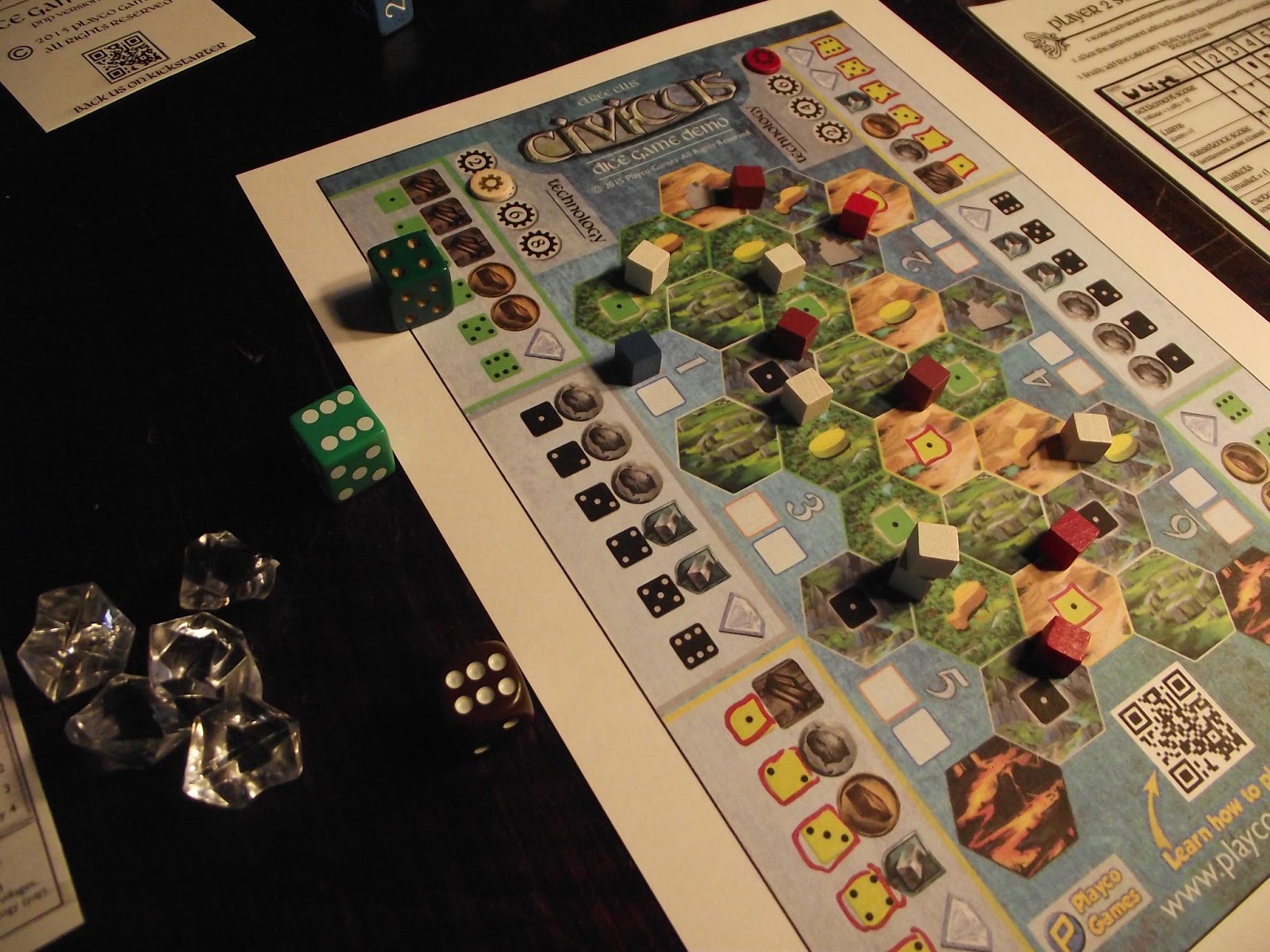
All set up and ready to go.
In Civicus Dice Game two players take on the roles of two civilizations competing for control of prime real estate on a map.  There are five main types of terrain: Mountains, Forests, Deserts, Sacred Sites, and Volcanoes.  These areas have symbols on them that represent Resources (dice), Farms, Markets, and Temples.  Each area has certain benefits when calculating scores in four categories: Subsistence (Settlements and Farms), Commerce (Markets and Exotic Resources), Theology (Sacred Sites and Temples), and Technology (Resources).  Depending on which areas you control you can either gain resources that allow you to expand and grow your Settlements and increase your Technology or gain the benefits of controlling Farms, Temples, Markets, and Sacred Sites.

There are three types of settlements in the game: Camps, Villages, and Cities.  Camps can be upgraded to Villages and then to Cities.  Each type of settlement exerts an influence over several of the hexagonal shaped 'domains'.  Camps are placed on the border between two domains.  If a Camp is upgraded to a Village it slides to one of the adjacent intersections between three domains.  And upgrading a Village to a City requires players to double up the settlement tokens they have there into a stack.  Camps exert one point of influence on domains they border, Villages exert three points of influence, and Cities have exclusive control of their domains.  The player that has the highest influence of a domain gets its benefits and if there's a tie neither player gets the benefits.  This sounds complicated, but it's all pretty simple once you see it in practice and the instructions do a great job of explaining the different types of settlements and their influence.
The demo game map.

Playing the Game

Play takes place over 6 rounds with each player taking a three phase turn each round.  Turns do not alternate, however.  The player that went last in round one goes first in round two.  This repeats for each subsequent round, so the turn order is 1,2,2,1,1,2,2,1,1,2,2,1.  This means the first player gets the first and last moves of the game, but the second player gets three double turns.

A turn is broken down into three phases.  In the first phase a player gets to place, move, or disband one Camp for free.  Positioning of this Camp is critical because it'll determine what kind of resources you get in Phase 2 or scoring benefits for Phase 3.  Positioning of this Camp can also affect the total influence in a domain to shift the balance one way or another.

Phase 2 is for extracting resources.  For any resource domains a player controls he can roll the corresponding dice (green for Forests, gray for Mountains, and Yellow for deserts).  The results of the dice indicate what resources were obtained.  There are five types of resources: Wood and Clay are readily available in Forests, Stone and Metal are from Mountains, and Deserts produce all four.  The fifth type of resource is Exotics (diamonds).  These are received from any area when a six is rolled, and from the Desert on fives also.  Exotics can be used to boost commerce score or as a wild resource of any other type.
I had red, brown, and green dice, so mine don't match what will
come with the game.  I also used cubes instead of settlement tokens.

Phase 3 is where resources are used.  This is the next phase where strategic decisions are important.  Despite being at the mercy of the dice you usually have several options for how to use the resources you've collected.  Only occasionally do you feel helpless or pigeonholed into undesirable choices.  More likely you'll have two or three meaningful choices that will really affect the strategy of your game.  You are most likely to have limited choices in the first round, or if your opponent manages to block you from gaining many resources in later rounds.

Resources can be used to place another Camp on the board (for two Wood), upgrade a Camp to a Village (two Stone), upgrade a Village to a City (one of each of the four main resources), or improve your Technology (varies depending on what tech level you're advancing to).  You can also trade resources to get what you need (two of the same for one of something else, or three of anything for one of something else), except for Exotics.  They can be a wild and take the place of any other one resource, or be used to collect a Diamond (which can't be traded) that will improve your commerce score.

A wood, clay, stone, and metal help White build a city!
And that's it for a turn.  When finished, you'll tally your score for that round.  Scoring is unique in Civicus.  There are four development tracks for your civilization and three of them (not Technology) has two attributes, but you can't score points in an area unless you have some of each attribute.  Subsistence is based on your Settlements and Farms.  Villages are worth one point and Cities are worth three.  The total value for Settlements will be multiplied by the total number of Farms you control.  So if you have two villages and two farms your Subsistence score will be four.  But if you have three Cities and no Farms you won't score anything for Subsistence, even though you have nine points worth of Cities.  The same goes for Commerce - you multiply the number of Markets you control by the number of Exotic resources you own, and Theology - Sacred Sites multiplied by Temples.  Technology is the only track that doesn't have a multiplier.

After six rounds have been complete players total their scores for all six rounds to get a total score and the winner is the player with the highest score.

My Thoughts

So I've played the game several times now and I must say, I was impressed in my first few plays.  As I played more, however a few flaws in at least the demo game became apparent. While there appears to be a variety of strategic choices in the game despite the inclusion of random dice rolls, there does seem to be one clear winning strategy.  And even though I almost always felt like I was left with enough choices to mitigate most of the luck factor, a string of lucky or unlucky rolls can have a huge impact.  This is not a forgiving game at all, due to is limited components, set number of six rounds, and obvious best path to victory.  A bit of bad luck can be difficult to overcome if it happens at the wrong time.

Civicus feels like a blend of Catan and Roll Through the Ages with a dash of tactical, abstract area control like Rise! or Tash Kalar.  The resource management and building aspect is less complex than in Catan or Roll Through the Ages but has a similar feel because of the reliance on dice rolls, but at the same time the area control aspect brings a strong flavor of abstract strategy.  I really enjoyed the overall idea, theme, and mechanics behind the game, but feel it needs a little more balancing.

The game plays in only 6 rounds, so it moves fairly quickly.  It'll take about 20-30 minutes after your first learning game.  I did feel like I'd have liked the game to go on a little bit longer, but at the same time I realize that the short game really rewards efficiency and forces players to pick a strategy and stick with it.  Because of the short time and reliance on dice rolls for resources the game is very implacable though.  A mistake in placement, or a few poor rolls and there isn't enough time to make up for more than the most minor of setbacks.  I felt like the game ended just as I was starting to get an engine going.  But I suppose that's part of the point of the game.  If it went on much longer the points would really start to roll in and then it would just be a matter of who gets luckier dice rolls.  So I guess it's best to end it at six rounds and then leave the players wanting more so they're excited to play again, although seven or eight rounds would probably still be effective.
What to do...  White has gained a wood, clay, and exotic this turn.
With two markets already controlled, two exotics already in stock,
and this being White's first turn in the final double turn of the
game, White has decided to take another exotic.
That paid off because for the last turn White places a camp to
control another Market and then rolls 2 more sixes!
White keeps those last two Exotics to end his game with
5 Exotics and 3 Markets for a whopping 15
commerce points in the last round.
That said though, the component restrictions in the game do pose a problem.  It's one thing for a game to occasionally feel restrictive because your choices are limited by the game mechanics; however, it's a completely different issue when your choices are limited because you've reached the maximums on every option.  In the last game we played, in my last two rounds I was very limited in what I could do because of being shut out of most of the resource spaces (my wife controlled 7 while I controlled only 4). That's unfortunate, but understandable.  My wife however, was also very limited in what she could do her last two round, but for her it was because she had maxed out on tech and had all her settlements on the board.  Points wise, that was a good problem to have, but it meant she ran out of meaningful choices two rounds before the game ended.  Most of her resources were wasted simply because she couldn't do anything with them.  Both of the problems we ran into resulted in a very unclimactic ending to the game.  For me because I was stranded with no resources, and for her because she had maxed out on all her possible development.

On my first two solo plays of the game the second player won each game by a significant margin.  Initially I felt it had to do with a combination of focusing merely on the Subsistence track and the fact that the second player got three double turns compared to only two for the first player.  That had me concerned at first, but the developer assured me that different strategies could be employed successfully to combat the Subsistence strategy.  When I played later with my wife we both took nearly the same strategy (and were actually tied through the fourth round), but she pulled ahead at the end with her final double turn (yes, she was the second player) and ended up winning by five points.  I later played another solo game and tried a different strategy for both players.  The second player still won.

Even though White is on the left scoresheet, it was the second
player and won by a landslide again.  Clearly either going second is
advantageous or focusing on the subsistence track is a great strategy.

I then played a few more games against my wife, with me going second and her playing first.  She destroyed me in both games.  So clearly any advantage going second has can definitely be overcome by the right strategy.  And for her, both times she went for building Settlements and controlling Farms.  I tried both times to go after Technology, Commerce, and Theology and had no chance against her.  It helped that she managed to build Cities in both games that knocked out Villages of mine and lost me resource spaces, so some of the advantage was due to some lucky dice rolls, but not all of the advantage can be chalked up to luck.  Part of the issue might be the demo map.  In this map two of the Farms are adjacent to at least two Resource spaces, meaning if you manage to build a village or city on one of those intersections you pretty much lock in a ton of dice rolls, plus the Farm multiplier for those Settlements.  I don't know what the maps to be included with the full game will look like, but they will have a few more domain spaces on them, so maybe the Farms and Resource spaces will be a little more balanced.

I played red and right after this my wife converted the white
village on the right to a city, effectively bumping one of my
villages and a camp off the map and securing the win for her.

I'm now doubtful that the second player has a great advantage with the extra double turn.  I think there's a small advantage, but as evidenced by the additional games I played with my wife, that can definitely be overcome.  Taking two turns in a row allows the first turn to be used to great advantage in setting yourself up for a major second turn.  The first player gets to go first and last, but they lose that huge advantage on those turns.  I'm wondering if changing up the play order to 1,2,2,1,1,2,2,1,1,2,1,2 might offset that advantage a bit, but it's clearly not a game killer.

But what I'm definitely convinced of is that the Subsistence track is much more powerful than any of the other tracks.  In every game I've played, the player that focused on building Settlements and controlling Farms won, and not by just a little bit.  Every time I tried to focus on any of the other tracks I was pretty much shut out.  The designer has assured me it is possible to win by focusing on other tracks, but I believe that's only possible if both players focus on something other than Subsistence.
The final layout of one of our games.  It may look like I control more
area (I'm white), but her red settlements include two cities, a village,
and a camp.  Plus she controls two farms, giving her a subsistence
score of 14 for the last round.  
With a score of 14 in the last round and 12 for each of the 
three prior rounds (1 city, 1 village, and 3 farms then 2 cities and 2 
farms), she nearly beat my total score with just her subsistence score.

Another feature of note about the game is the size.  The demo that I printed was tiny, so I enlarged it to fit on an 8.5" x 11" sheet of cardstock.  This made the actual map area about 7.5" long, about the same size as the final game maps.  The final box size will be 8" x 5",  That's not quite a mini game (like the Tiny Epic line), but it's definitely on the smaller side; small enough to fit into a backpack, larger purse, or even a pocket on cargo pants.  I love games this size  because they're easy to take with just about anywhere.  The only issue is I find that I want to throw them all into my bag on the way to game night and I'm starting to get such a large collection of smaller games that they about fill up a bag on their own! =)  But games this size are great to bring just about anywhere; camping, picnics, game night, restaurants, etc.
The components that will be included in the
base game, plus any stretch goals.

One other, minor thing to note though, my wife was a little concerned that the Sacred Site tiles were a little difficult to discern from the forest tiles though.  I didn't have this issue (yes, both types are green, but Forest tiles have a Die, Farm, Market, or Temple symbol on them), but if you have trouble discerning details or are tone or color blind you may have a little more difficulty quickly identifying the different domain types.  My only concern was with the symbols that were used to represent Farms, Markets, and Temples.  They had the appearance of wooden tokens lying on the domain spaces and the graphics didn't quite meld with the somewhat realistic look of the rest of the graphics.  The stylistic look does serve a purpose by making the area type easy to identify, but it kind of clashes with the rest of the graphics.  Also, the terrain type that the Farm/Market/Temple icon is on is completely irrelevant since you don't get any resources for that domain, just the scoring benefit.

What I'd Change

So, as you can tell, I'm on the fence with this game.  It was fun, and has a lot of potential, but I think it needs a bit of tweaking.  I'd like to see a few changes made to the game to maximize replayability, minimize luck, and balance the tracks a bit more.  Some of this can be done with more varied maps, but you'd get a nearly unlimited variety of maps by composing the maps from tiles that contained three or four domains on each one.  This would allow for bigger maps, smaller maps, various layouts, and a new strategic puzzle to figure out with each game.  I'd also like to see more balance between the tracks.  Maybe for the Subsistence track Farms don't multiply Village/City scores, but each Village or City requires a farm to be controlled.  Or maybe the Technology track gives extra bonuses to the Commerce or Theology tracks.  I'd also like to see the Technology track go up to twelve, or at least ten so that it's less likely to be maxed out.  Same for the number of Settlement tokens.  While six settlement tokens means you have to decide carefully how they'll be used, the combination of running out of settlements, and maxing out on technology is very frustrating because even though you may have the resources to do more toward the end of the game the components are limiting.

Final Comments

I played Civicus six times and of those six, twice the components were the limiting factor in the end game for one player, twice lack of resources were the limiting factor in the end game for another player and every time the player that went after Settlements and Farms won by a significant margin.  These are indicators that the game, though fun and promising, needs a bit more work.

The base game is selling for $25 at https://www.kickstarter.com/projects/playcogames/civicus-dice-game and for the price this is worth considering.  The game mechanics are solid, it plays quick, and scratches that itch for a light strategy game.  I love the size, theme, and gameplay.  Despite some balancing issues (which might be resolved by better maps, a few rule tweaks, or a few additional components), I think it offers a decent amount of replayability with several different maps included in the base game.  Hitting several stretch goals will introduce new maps, new mechanics, and a 3-4 player expansion!  I'm especially curious to see how the game scales to 3-4 players.  If all of those stretch goals are hit then this would be an incredible value for $25 (it's a solid investment as it is).  If any of this sounds like it's up your alley, definitely check out Civicus Dice Game.

Preliminary Rating: 6.5/10

This review is of a prototype game.  Components and rules are not final and are subject to change.


Did you like this review?  Show your support by clicking the heart at Board Game Links , liking GJJ Games on Facebook , or following on Twitter .  And be sure to check out my games on  Tabletop Generation.


GJJG Game Reviews are independent, unpaid reviews of games I, George Jaros, have played with my family and friends.  Some of these games I own, some are owned by friends, some are borrowed, and some are print and play versions of games.  Where applicable I will indicate if games have been played with kids or adults or a mix (Family Play).  I won't go into extensive detail about how to play the game (there are plenty of other sources for that information and I'll occasionally link to those other sources), but I will give my impressions of the game and how my friends and family reacted to the game.  Quick Reviews will only get a single rating of 1-10 (low-high) based on my first impressions of the game during my first few times playing.  Hopefully I'll get more chances to play the game and will be able to give it a full review soon.

Tuesday, June 2, 2015

Quick Review - Sultan's Library - Kickstarter Preview

Sultan's Library
Designer: Ryno Lourens
Publisher: Photon Games
Quick Review - Sultan's Library - Kickstarter Preview
Disclaimer

I received a copy of Sultan's Library to review prior to their Kickstarter re-launch.  Their first campaign in March was unsuccessful and they are hoping for a better campaign in June.  You can get the gae for about $18 USD ($22 CAD) from their current campaign here: https://www.kickstarter.com/projects/369033234/sultans-library-untold-riches-await-within

Overview

In Sultan's Library players take on the role of envoys of the Sultan as they explore the realm in search of books of knowledge to add to the Sultan's library.  Players explore various locations, find books, and bring books back to the library, all while encountering various events and trying to undermine each other's efforts.
This is the Sultan's Library, where you are trying to bring books to.

Sultan's Library consists of two decks of cards, a Location deck with location, book, and event cards, and an Action deck with action and journey cards.  There are also four player tokens, a first player token, and a large Sultan's Library starting location card.  The prototype copy I received only had a few pieces of completed art and it was functional, but nothing stunning.  The artwork is done in an awkwardly angular style that reminds me a bit of MTV's Æon Flux.  I like it, but the characters and items are just dropped onto a mainly white background that has a very light watermark of a location in a circle.  The graphic design and layout is very basic, with simply the artwork, name of the card, ability text, and flavor text.  Books and locations also have an icon in the top left to indicate the explore points or knowledge points of the card.  And each card has a simple line and icon separating the main artwork from the text in one of five colors that denote the card type.
Some of the Locations, Events, and Books that already have artwork.

Journey and Action cards that have artwork.

A turn in Sultan's Library consists of players drawing cards from the Action deck, then playing two Actions, which may consist of playing action cards, exploring the location they are in, travelling to another location, and several other options.  Action cards have various effects on either the current player, his opponents, or both.  To explore a location players must spend journey cards that have explore points that equal or exceed the explore cost for a location.  Doing so may result in an event, which gets resolved immediately, finding a book, which can be picked up later for an action, or finding a new location, in which case the player immediately travels to the new location (and discards the location he had just occupied).  The first player to bring three books back to the Sultan's Library triggers the end game (completing the round) and the player with the most knowledge points (based on the books deposited in the library) wins.
The characters you can choose from and the Sultan's Library.

Playing the Game

The concept behind Sultan's Library is simple and the premise is somewhat interesting, however the execution leaves a whole lot to be desired.  The game is 90% luck and only gives the illusion of control or choice.  Part of this is because of the limited creativity in the card abilities, part of this is because the game is wildly unbalanced (or maybe too balanced between good and bad cards), but mostly this is because of the awful location mechanic.  When you explore a location you may find one of three card types, a book (which is good, and there are fourteen of them), an event (which can be good or bad, but with ten bad cards and six good cards, you're more likely to find something that'll hurt than help), or a location.

The Wise Old Hermit may look helpful at first, but looks can be deceiving.
There are thirty location cards, so 50% of the cards are locations.  So there's a pretty good chance that what you'll discover when exploring is another location.  This is great, except for one thing.  When you discover a location you MUST travel to it immediately.  You don't have any choice in the matter.  So if you were thinking you might be able to use a location's abilities to some strategic end, think again.  Exploring a location may just send you away from it.  You have no choice.  Oh, and remember what I said about the game being 'too' balanced between good and bad cards?  Of the thirty location cards, nine are what I would call good locations.  These have abilities like "You do not have to use an Action to Pick Up Books in this Location", or "When you Travel to this Location, draw a card and gain an Action."  Seven are what I'd call marginally good.  These give you a benefit, but require a sacrifice.  Their abilities are things like "As an Action you can gain 1 Explore Point", or "As an Action, you can discard a card to explore the area."  So there are sixteen good location cards, but there are also fourteen bad location cards.  Of these fourteen, only one would I classify as marginally bad (i.e. a big sacrifice gives you a very small benefit).  The Beach Cottage says "When you travel to this Location, discard a card and gain an Action."  It also only costs one Explore Point to explore the Beach Cottage.  The other thirteen locations are harmful, with abilities like "If you start your turn in this Location, lose one Action", "You can not Explore the Area in this Location", "When you Travel to this Location, discard 3 cards", or "When you Travel to the Mountainside Temple, discard all cards."  And remember, most of the time you won't have any control of whether you travel to a location or not.  So, by absolute random luck of the draw, you might be sent away from a good location to one that'll cause you to lose all your cards, be very difficult to leave, or hurt you every round you're stuck there.
Starting a turn in the Farmstead means you only get to draw one Action card.

And to top it off, the location you were previously at gets discarded.  This means in a four player game you'll have, at most, four possible locations to choose to move to if you decide to move during your turn instead of explore.  But this number could be even less because it's possible for several characters to be in the same location.  The only permanent location is the Sultan's Library.  So if in a four player game one player is in the Sultan's Library, two are in the Beach Cottage, and you are in the Thick Jungle, you'll only have the choice of traveling to the Beach Cottage or Sultan's Library.  And as soon as you move the Thick Jungle gets discarded, leaving other players with even fewer choices.
Searching for books to add to the Sultan's Library.
So, with sixteen good locations, fourteen books, and six good events that makes thirty-six beneficial cards in the Location deck. Fourteen bad locations and ten bad events makes twenty-four harmful cards in the Location deck.  That means two out of five explorations are going to hurt you, and possibly even higher since some of the events tell you to discard cards from your hand and then reveal another location card, which could be another harmful event or a bad location.
When the Poet leaves this location it'll get discarded, even if he's
forced to leave because of exploring and finding a new location.

Now, let's look at the Action cards that you may have in your hand to use as an action, since you've realized that exploring an area is pretty risky.  In the Action deck there are thirty-three Journey cards that will give you from 1 to 6 explore points.  There are also twenty four action cards.  These action cards fall into four types.  There are nine helpful actions, three mildly helpful actions, six attack actions, and six defense actions.  In all there are eight different cards with three copies of each.  So in actuality there are only three helpful actions, one mildly helpful action, two attacks, and two defenses.  That's not a whole lot of choice when it comes right down to it.  And the attacks are pretty vicious - one makes an opponent discard a book that they've already deposited and the other makes an opponent lose one of their two actions on their next turn AND discard two cards (that is a lot when there's a five card hand limit and chances are you'll only have two to three cards left at the end of your turn).  The mildly helpful action lets you discard up to three cards to gain that many actions, but remember, it takes an action to play that card, so in reality you can gain up to two actions by discarding four cards (the Motivation action card, plus three other cards).
Actions aren't always helpful, and can sometimes destroy your opponents.

The good cards let you explore or travel without spending explore points, draw extra cards, or deposit a book even if you're not at the Sultan's Library, so those are very nice, even if they do take an action to play.  The defense cards are pretty standard, letting you discard them to avoid an attack action or event card; however, with six attack actions and ten bad events with only six defense cards you're still way outnumbered (and the defense cards do nothing to offset a bad location).  Additionally, one of the defense cards (Extra Guards) tells you to also flip the top card of the Location deck.  It's unclear if that card's effects happen to the defender or the attacker in the event the Extra Guards was played during an attack action, but regardless, with so many harmful cards in the Location deck it's likely that playing that defense card is going to hurt someone.

Final Thoughts

With so much going on in this game to hinder your ability to accomplish its goal, it's amazing that anyone is able to deposit the three books in the Sultan's Library.  There is a lot of conflict and setback in the game, but unfortunately most of it is due to just random card draws and not any real strategic planning on the part of the players.  Each turn felt more like an exercise in trying to mitigate the bad luck than in actually trying to accomplish anything.  I felt like my character was being sent from location to location without any real reason and I couldn't go back to a location I liked because it disappeared as soon as I was forced to leave it.  There is no real sense of exploration or gaining knowledge.  This is a game of having stuff happen to you rather than a game that you control.  And very little of what happens to you is helpful, or even interesting or fun.
Sultan's Library is an exercise in letting stuff, usually bad stuff,
just happen to you without any rhyme or reason.

The theme of the game also seems to get lost in the debilitating mechanics.  As envoys of the Sultan players shouldn't be quite so destructively competitive.  If the Sultan has tasked all of us with finding books, why is Book Burning an Action that I can play?  I could see that as an event that happens to you, but as an Action it seems to be directly contradictory to the theme of the game.  I also have a big problem with how often and easily the Location cards get removed from the game.  If the theme is to travel about the land searching for books, forcing players to leave their locations and then removing already visited locations from the game just doesn't mesh with the theme.
Two players can share a location, but as soon as they both
leave it (probably against their will) the location will vanish forever.

So while the general idea behind Sultan's Library is mildly interesting, as a pick-up and deliver type game, it plays poorly.  The games needs a lot more playtesting to work out ways to make the decisions and interactions between players interesting and meaningful and make the game feel less like a nightmarish ride through randomness.  At a cost of about $18 US ($22 Canadian), this won't hurt your wallet too much, but for me it's still a pass.  There are a lot of much better games that you can spend $20 on.  If you are still interested though, you can check out their campaign here: https://www.kickstarter.com/projects/369033234/sultans-library-untold-riches-await-within
You get 4 Knowledge Points for the Forbidden Journal,
but better to just save your money.

Preliminary Rating: 2/10
This review is of a prototype game.  Components and rules are not final and are subject to change.


Did you like this review?  Show your support by clicking the heart at Board Game Links , liking GJJ Games on Facebook , or following on Twitter .  And be sure to check out my games on  Tabletop Generation.

GJJG Game Reviews are independent, unpaid reviews of games I, George Jaros, have played with my family and friends.  Some of these games I own, some are owned by friends, some are borrowed, and some are print and play versions of games.  Where applicable I will indicate if games have been played with kids or adults or a mix (Family Play).  I won't go into extensive detail about how to play the game (there are plenty of other sources for that information and I'll occasionally link to those other sources), but I will give my impressions of the game and how my friends and family reacted to the game.  Quick Reviews will only get a single rating of 1-10 (low-high) based on my first impressions of the game during my first few times playing.  Hopefully I'll get more chances to play the game and will be able to give it a full review soon.

Monday, April 27, 2015

Quick Review - Button Bashers Turbo - Kickstarter Preview

Button Bashers Turbo
Designer: Nate Moore
Publisher: Multi-Bit Games
Quick Review - Button Bashers Turbo - Kickstarter Preview
Disclaimer

Overview:

Hitting Kickstarter at the end of April is the latest game from Multi-Bit Games.  Back in June of last year (2014) Multi-Bit Games had a small, but successful campaign for their game Button Bashers.  Now they're back with Button Bashers Turbo, a very similar game with some modified mechanics that add more choices for players throughout the game.  They were nice enough to send me a copy of the prototype cards and a draft set of the rules.

UPDATE: The Kickstarter campaign for Button Bashers Turbo went live on April 29th and runs through May 28th.  The base game is $19, including shipping to the US.  You can visit the campaign here: https://www.kickstarter.com/projects/multibitgames/button-bashers-turbo


Button Bashers Turbo is designed primarily for two players but it can also be played by 4 players in a free-for-all melee or tag-team matchup.  I played the two player version.  Each player chooses two fighting characters that resemble 90's style arcade characters.  These characters each have a set of unique special abilities that come into play as they perform combo attacks on their opponents.  Attacks are performed by playing a series of cards that represent buttons and joystick movements on an old school arcade machine.  OK, let's back up a bit...

The Gameplay:

After players choose their characters they set a slider on the cards to give each character full health (20 HP).  Then they choose one of the two characters to be the active fighter.  Next, the Stage deck is shuffled and one card drawn to set the scene of the combat for the first round.  Players also take a single Block card.  Finally the Button and Direction cards are shuffled (called the Bash deck) and placed face down (with the Bash side up) and each player draws two.  Now players are ready to start.
Slamu the Slammin' Salmon and Catbeard the Scoundrel
are ready to battle Fred the Zombie Gunman and OpanGi
the Seasoned Warrior.

On each player's turn they complete three phases.  The first phase is called the Bash phase and players draw as many cards as indicated on the top card from the Bash deck.  The player can choose three of the cards drawn and discard one.  If the Bash number was a 7 then the effects of the Stage card for the current round also take effect.

The second phase is the meat of the game.  The Action phase is where the player chooses an action to take.  He can either Block, Swap, or Burst.  Block and Swap are relatively simple, but Burst is where the fighting actually takes place.

If a player chooses to Block he places his Block card in front of him.  He can then shuffle any number of cards from his hand into the Bash deck (not into the discard pile) and then draw that many cards plus one from the Bash deck.  His turn then ends, however any damage done to him on his opponent's next turn is reduced by half.

If a player chooses to Swap he switches his active character with his benched character.  The new fighter can then make one attack (following the rules in the Burst section, except the character can only perform one attack instead of a combination of many attacks).  Also, the newly benched character can recover 3 HP.
The graphics bring a sense of 8-bit arcade game nostalgia!
The Burst action is how players deal damage to each other.  Burst allows the player's active character to perform multiple attacks, with each one increasing in intensity.  To attack the player looks at the available attacks for his active character.  Attacks consist of a combination of direction and button cards.  Each character has its own unique set of valid combinations.  For example, playing an Up card and a Button may be a valid attack combination for one character, but not for another.

The amount of damage done in an attack depends on the button used.  Buttons can be light, medium, heavy, special, kick, or turbo.  Light, medium, heavy, and special buttons do 1, 2, 3, and 4 points of damage respectively, turbo lets the player draw another card, and kick lets the player change their opponent's active character so they can continue attacking the other opponent character (although the combo count is reset to 0 when the new character comes in).  All players also have access to two common attacks - a jab is a single button that always does 1 point of damage (regardless of the type of button used) and a hyper combo uses all four of the damage dealing buttons (for 10 points of damage) and cancels out an opponent's block action (for subsequent attacks as well).

So I've mentioned a few times multiple attack combos.  During the Action phase, if the player chose the Burst action they can perform as many attacks as they like.  Each attack inflicts one additional damage point.  This is in addition to the damage from the button(s) used.  The first attack does 0 additional damage, but the second attack does 1 additional damage, and a third attack would do 2 additional damage.  So the more attacks you are able to string together in a turn the more damage you'll do.
Buttons, joysticks, and 8-bits, oh my!
As soon as a character reaches 0 HP they are out of the game.  The player then only has one character to continue fighting with and can't use the Swap action.  Additionally when an opponent plays the Kick button it has no effect on a player with only one remaining character.  The player with the last character standing wins.

Going Deeper:

Those are the core rules of the game, and they're pretty straight forward.  Where the game gets challenging is in the other effects each character's various attacks have.  This is, at the same time, the most interesting and most problematic aspect of the game.  It's here that any elegance to the mechanics is lost.  In addition to the damage that an attack does through the buttons used in it and any combo bonus, each attack has another effect that may or may not come into play.  This is a great idea, but I found the effects to be unnecessarily complicated and a huge detriment to the momentum of the game.

Each character has 6 special attacks in 4 levels (1 blue, 2 green, 2 yellow, and 1 red in increasing complexity).  But even the simplest attacks have somewhat complex effects.  For example, if you use OpanGi's blue level Jaw Breaker attack (up and a button) you have to look at the top card of the Bash deck.  If it's Bash value is 3 then your opponent discards one card and the top card of the Bash deck is also discarded.  OK, that's not that challenging and it results in something simple happening (your opponent discarding a card) some of the time.  But OpanGi's green level Spam Ball attack (right and a button) has the exact same effect if the top card of the deck is a Bash 5.

Now let's look at Mrs. Soft Serve's blue level attack, Ice Barrier (a combination of any two left and right direction cards): Reduce the total damage you take next turn by 2 for each time you've used this attack.  OK, it's still a simple effect (negating less damage when you are attacked next), but it's starting to get more complicated since you now have to remember on your opponent's next turn how many times you used the Ice Barrier attack.  But how about some of her other attacks?  Delicius Downpour, a green level attack (up and a button) says: Until the end of your turn, increase the [clock icon] by 1 for the sake of your attacks only.  If you used Ice Barrier this turn, increase by 2 instead (Max round is 5)  I'm assuming that the final instructions will explain what the clock icon means.  I'm assuming from the last text in parentheses that it represents the round number, but I'm not sure.  If it does mean the round, then that means the yellow level Let It Go attack (down, left, button) could actually be harmful in round 1 and of very little help in round 2, unless you are able to play Delicious Downpour and Ice Barrier first.  Let It Go's effect is: Draw cards equal to the [clock icon]. Than [sic] discard 2 cards.

How about Boz-o the Wize?  He's a level 4 difficulty character.  His blue level attack, Surprise! (up and a button) has this effect: Put one button in play face down.  This is a SURPRISE.  When your opponent attacks, discard any SURPRISE that matches the button from that attack.  Deal that button's damage.  Otherwise, add SURPRISE back to your hand before you bash.  Woah.  It took me three times reading that to figure out exactly what I was supposed to do, and I'm still not completely sure I understand.  Apparently I'm supposed to take an additional button card from my hand (or is it the button used in the attack?) and place it face down in front of me without my opponent seeing it.  If my opponent uses that button in an attack against me it basically backfires and hits my opponent instead, most likely leaving the opponent's adjusted attack (without the button that I chose) ineffective.  OK, I guess that's kind of cool, but that's the simplest effect?  Boz-o's yellow level Flower Squirt Surprise (right, up, button) tells you to check the bottom card of your deck.  If it is a directional card, add it to your hand.  If it is a button, put it face down in play.  This card remains in play with an effect.  When you use Surprise! it becomes a SURPRISE.  First of all, I'm assuming you check the bottom card of main Bash deck since each player doesn't have their own deck.  Second, what does it mean that the card remains in play with an effect?  And what happens if I don't play a Surprise! attack this turn?
6 attacks each with various effects for 12 different
characters means it'll take a long time to get comfortable
playing any character combinations. 

Individually these effects are interesting.  Combined, and having six different effects on each player makes the attack phase, which should be a quick, action packed phase, drag as players try to read, understand, and use various attacks with a multitude of strange effects.  I can see where if you played this game a lot, and funny understood each character's attack effects, this would move quicker and you'd be able to plan a bit.  But there are so many effects that make you and/or your opponent discard cards, draw new cards, swap cards, etc. that planning for the future is difficult at best.  It's definitely a reactionary game, which I suppose a fighting game should be, but I think it would work much better with simpler, more generic attack effects, especially for the lower level attacks.  Simple effects like drawing extra cards, opponent discarding (or drawing/keeping fewer cards on their next Bash), increasing damage, etc. would be quick to choose and process.  The more complicated effects should be saved for the yellow and red level attacks.

Another issue with the effects is how many of them have exceptions, conditions, or different behavior based on other events.  And a lot of those exceptions and conditions don't just apply to the current turn, the trigger on future turns, or rely on things that happened in previous turns.  It all leads to confusion and a bit of analysis paralysis, especially for newer players that aren't intimately familiar with each character.

Final Thoughts:

I really wanted to like Button Bashers.  I was never a huge fan of arcade fighting games, but I spent my fair share of time in the arcade or in front of a console battling friends, and this seemed like a cool trip down memory lane without having to fire up the old NES.  The core idea behind the game isn't too bad and has potential, but the sheer variety of moves that each character has available make this a game that's not going to be easily accessible by the majority of people.  This game is not a casual game to teach to new players.  It's unnecessarily complicated and feels more like work than a fast, fun, action packed experience.  In fact, both my son (who loves video games and was super excited to play this game) and my wife got frustrated with the game and quit well before round 1 was finished.   And honestly, I was relieved and ready to move onto something else, too.

Where I see Button Bashers Turbo finding a niche is with players who both enjoy the nostalgia of arcade fighting games and want to take the time to play this repeatedly with the same character.  Like an arcade game, once you start to learn your character and his special moves and abilities (and your opponents' moves and abilities) you'll be able to strategize and react quickly.  But until you've overcome that huge hurdle of becoming intimately familiar with each character you'll be stuck reading and re-reading and trying to figure out each move and what it's effects and ramifications are and how it combos with other moves... in an ongoing mess of analysis paralysis, and this isn't the type of deeply strategic game that lends itself to that type of deep thinking.  Or maybe you'll just give up trying to plan a strategy and you'll just play whatever cards you get in random moves and take whatever consequences pop up.  The trouble with the "mash the buttons and hope you get a few hits in" approach though is that there aren't enough generic, common moves that you know will work for every player.  Every fighting game I ever played had a set of core moves that every player could do, like a kick, punch, leg sweep, block, jump kick, etc.  Even if I didn't know all the character's special moves I at least knew I'd get a few hits in and maybe luck out on guessing a combination.  That doesn't really happen in Button Bashers Turbo though since every attack is part of a combo and has special effects that need to be resolved.
The box looks like a cool retro arcade game.

Button Bashers Turbo has an interesting idea, but really needs to be streamlined to make it accessible and appealing to a wider audience.  Those willing to put the time and effort into really knowing and understanding the abilities of each character will probably find an entertaining game here, but for the masses it'll be an exercise in frustration and not a game that will be fun or easy to introduce to new players.  Unless arcade style fighting games are really your thing, I can't recommend backing Button Bashers Turbo.

UPDATE: The Kickstarter campaign for Button Bashers Turbo went live on April 29th and runs through May 28th.  The base game is $19, including shipping to the US.  You can visit the campaign here: https://www.kickstarter.com/projects/multibitgames/button-bashers-turbo


Preliminary Rating: 4/10
This review is of a prototype game.  Components and rules are not final and are subject to change.

Did you like this review?  Show your support by clicking the heart at Board Game Links , liking GJJ Games on Facebook , or following on Twitter .  And be sure to check out my games on  Tabletop Generation.

GJJG Game Reviews are independent, unpaid reviews of games I, George Jaros, have played with my family and friends.  Some of these games I own, some are owned by friends, some are borrowed, and some are print and play versions of games.  Where applicable I will indicate if games have been played with kids or adults or a mix (Family Play).  I won't go into extensive detail about how to play the game (there are plenty of other sources for that information and I'll occasionally link to those other sources), but I will give my impressions of the game and how my friends and family reacted to the game.  Quick Reviews will only get a single rating of 1-10 (low-high) based on my first impressions of the game during my first few times playing.  Hopefully I'll get more chances to play the game and will be able to give it a full review soon.

Tuesday, April 7, 2015

Quick Review - Ion: A Compound Building Game - Kickstarter Preview

Ion: A Compound Building Game
Designer: John Coveyou
Publisher: Genius Games
Quick Review - Ion: A Compound Building Game
Disclaimer

As a homeschooling family that loves both science and games, educational science games are right up our alley.  Unfortunately many educational games are just trivia or 'flash card' type questions mashed up with stale roll-and-move mechanics.  So when we find games that purport to be equal parts educational experience and game, we jump on it!

I was fortunate enough to receive a prototype copy of the newest game from John Coveyou and Genius Games, Ion: A Compound Building Game.  If you aren't familiar with John and Genius Games, be sure to check them out.  Ion is the third game in John's collection of science based games.  His first game, Linkage, teaches about DNA Transcription and was listed in Popular Science's list of 10 Best Things for February 2015.  The second game, Peptide, teaches about RNA to Protein Translation and had a successful Kickstarter campaign last fall.  John Coveyou was also involved in the hugely successful Tesla vs. Edison game as well, although not through his Genius Games company.  Ion: A Compound Building Game is all about bonding ions at the atomic level to create more complex compounds and is Genius Games' latest game to hit Kickstarter.  The campaign launches on April 8th here: https://www.kickstarter.com/projects/geniusgames/ion-a-compound-building-game

UPDATE: Ion has successfully funded!  Congratulations to Ion for successfully funding in less than 24 hours!  The game has already added a number of stretch goals and is well on its way to adding more!  Read my review of the base game below, but be sure to read my UPDATE that includes information on how some of these stretch goals change the game.

Overview

So, how does Ion stack up as both an educational tool and a game?  Well, let's start by explaining a bit about the components and how to play.
Set up and ready to play Ion: A Compound Building Game.

The game, as I received it, contains 47 charged ion cards (representing ions like Chloride, Hydrogen, Fluoride, Potassium, Magnesium, etc.) and 18 noble gas cards (Helium, Neon, and Argon).  There are also 8 sets of three action tokens and 7 compound goal cards.  The element cards include a representation of the element's atomic structure as well as game critical information.  The only flavor text on the element cards tells the type of element (e.g. Halogen, Alkali Metal, Noble Gas).  The prototype compound cards have no artwork, but they do have flavor text that tells a little about each compound.  The prototype action tokens only have functional text and a simple graphic of an atom.  While the artwork on the prototype cards is sufficient, the final game will have much nicer artwork, including pictures of what the compounds are used for.
Elements, Compound Goals, and Action Tokens make up the game.
The final artwork on the cards will be much more visually attractive.
Elements show even more detail in the atomic structure, compounds
show what the compound is used in, and everything pops!

Playing the Game

So, how does the game play?  The core mechanic in the game is card drafting.  The secondary mechanic is matching.  Each player starts with a hand of 8 cards and will choose an element (ion) card to add to their tableau and then pass the rest to the player on their left.  After the first turn each element card can either be bonded (matched) to an already played ion in an effort to build a balanced compound (i.e. matching negatively charged ions with positively charged ions to create neutral compounds) or played unbonded (on its own) in the hopes of being able to bond it to something else later.  The only exceptions to this are the noble gas cards, which are already balanced and can't be bonded to any ions.  Play proceeds until each player has a hand of three cards to choose from.  The player then chooses one card and discards the two remaining cards.  Then the player's tableau is scored (each element card has points on it and players score for all balanced compounds they have created).  Then all the cards are cleared away, shuffled, and the whole process is repeated two more times for a total of three rounds.  The winner is the player with the most points.
Two Sodium Chloride compounds are bonded and Fluorine
is waiting for an ion to bond with.

To mix things up a bit, though, there are compound goal cards and three action tokens that each player has.  There are 2 or 3 compound goal cards laid out in each round that give you bonus points if you are able to construct one or more compounds.  These allow for a few choices when playing cards, other than just choosing a card from your hand.  You can work towards compounds that will give you extra points or use an action token to select two cards from your hand, get an extra card from a set of four laid out in the middle of the table at the start of each round, or initiate a reaction.  But the action tokens must be used sparingly.  Each action token gives you an added benefit, but also costs some negative points, and each can only be used once per game.

That's it for gameplay.  It's a very simple drafting and matching game with a few common goals.  I taught the game to my family in about 5 minutes (ok, about 15 after my wife spent 10 pulling out chemistry books and explaining to my 8 and 5 year old boys what ions and compounds are).  The game played fairly quick, with each round taking about 5-10 minutes and even that would have been even quicker without the interruptions of a dog that had to go out, then in, then out, and in again.  The game can easily be taught to a group of students and played during the course of a single class period.
I scored 18 points this round for my two noble gas cards, Hydrochloric
Acid, and Hydrogen Fluoride.  Plus 5 points for building both acids
on the compound goal card netted me 23 points in this round.

The Review - be sure to read my UPDATE that includes information on how some of these stretch goals change my opinion of the game.

So, was it educational?  Somewhat.  It was a very basic introduction to ionic bonding and building compounds.  And the compound cards do have a nice explanation about what each compound is (e.g. HF - highly corrosive acid that can dissolve glass, and many types of metals and plastics.).  But the compounds that you create are very simple; HCl, NaCl, KOH, etc.  The most complex compounds are alkaline earth bases like Mg(OH)2 and alkaline earth salts like Ca(F)2.  So yes, the game teaches the basics of ionic bonding, but doesn't go too far.  It's a fun alternate to your traditional educational game and has a mechanic that most students probably won't be familiar with, which will make it more interesting in a classroom environment than your typical trivia type educational game.  But it's not going to be a great teaching aid for more than one or two lessons on basic ionic bonding principles.  Once the topic advances to polyatomic ions, more complex compounds, and balancing complex equations the usefulness of the game as a teaching aid will quickly be surpassed.

However, there will be some stretch goals in the Kickstarter campaign that will be able to help extend the life of the game in the classroom.  I was unable to preview any of the additional features these stretch goals will add to the base game, but adding in polyatomic ions, radioactive elements, and a ph scale.  These should add in a lot more advanced concepts, as well as more player interaction and game complexity, hopefully in easy to explain increments so that the game can grow as the educational subject matter advances.
Cards have a minimal amount of educational flavor.  Maybe atomic
weights or some other facts about the elements would be useful.

But was it fun?  Yes, we had fun playing.  The game moved quick enough that it kept both of my boys engaged.  My 5 year old doesn't do well with a lot of player downtime and since there really isn't any downtime (especially when you're the slowest one at making the decision of which card to play) this really kept him engaged, plus it was easy enough for him to pick up almost immediately.  However, I can see the core game getting old pretty quickly.  There is very little player interaction and very little decision making in the game.  It really played as if each player was playing a solitaire game of matching.  Cards are either going to match or they aren't.  Everyone is aiming to build the same goal compounds and there are generally enough cards to go around that each player is going to be able to build one or two of the goals without any trouble.  There really weren't any synergies between the cards and none at all between players unless someone decided to play a reaction token.  But even then the reaction only applies at the end of a round and only to unbonded ions that opposing players weren't going to score points for anyway.

My Thoughts - be sure to read my UPDATE that includes information on how some of these stretch goals change my opinion of the game.

So I guess overall I was disappointed in the game.  Yes it's a different type of educational game.  Yes it has more 'gamer' elements in it than your typical educational game.  But it was very light, very simple, and not deep at all in the subject matter or game complexity.  I think my biggest disappointment though is that the game could be so much more.  When I first read the description I had high hopes for the game, and after playing it I still think it has some great potential.  But as it is now it falls way short of what it could be.  Hopefully the stretch goals will change that by adding more complexity and more player interaction, but unfortunately they weren't in the game that I tested and will only be in the final version of the game if some stretch goals are reached.
All the game boiled down to was matching + and - symbols on cards.

What do I think could make it better?  I'd love to see improvements to the mechanics and depth of strategy to the game included from the get-go.  I love the idea of having to build compounds using ionic building blocks.  But each round is essentially the exact same thing.  There is no sense of building toward a bigger goal.  Other drafting games like 7 Wonders grow in complexity each round, allowing you to lay a foundation early in the game, and then build on that in later rounds.  Cards have interactions that give you additional abilities.  What you build depends on what your neighbors are building, so you want to keep an eye on both what you are getting and what you are passing to your neighbors.  The base game of Ion has none of that.  For the most part I couldn't care less about what my neighbor is building.  I know they're trying to make the same matches I am, so if I can grab a card that benefits me I'll grab it.  It all comes down to the luck of a random distribution of cards.  The end score would be pretty much the same if we just turned 32 cards face up and let players take turns selecting one at a time until each player had chosen 6.  Even as a filler or opener game on game night, Ion is too simple to have much replayability.  I don't see it getting to the table more than once or twice outside of a classroom.

The game has so much potential though.  It's a great idea, but it just feels underdeveloped (or maybe oversimplified from a bigger game).  I understand the desire to keep it simple enough to teach in a few minutes in the classroom, but I'm not sure that's absolutely necessary.  Maybe the classroom environment has changed in the 20+ years since I was in high school, but in my history classes we played games like Avalon Hill Civilization and Diplomacy.  They were complex, took a really long time to play (many class periods - the boards would be set up for months), and had everyone absolutely fascinated and engaged.  I don't think Ion aims to be that type of game, but somewhere in between I would think would be a great bridge between quick, overly simplistic educational games that don't leave the classroom and more complex gamer games that people want to play at home with family and friends, too.

Even something as simple as giving each player their own compound goal to work toward each round, instead of having shared goals, would increase the player interaction immensely.  Then I'd have more of a decision to make.  Do I grab this Hydrogen to make HCl, which will give me a bonus, or should I grab the Sodium to make NaCl, which won't give me a bonus, but will prevent my neighbor from making NaOH to get their bonus...  Or maybe bigger changes could incorporate different sets of cards for each round so you could keep your tableau out after each round and work toward bigger and more complex goals.  You could have basic ions in round 1 so you can work on building either simple compounds that you score that round, or unbalanced polyatomic ions that you won't score in round 1, but will help you build much more complex compounds for bigger scores in later rounds.  Have interactions with other players' compounds, too.  Maybe an element you play reacts with a compound that a neighbor has built.  Play Mg and your neighbor's two HCl compounds react to create MgCl2 and H2.  Maybe if reactions are exothermic you get bonus points, or if they're endothermic your opponent loses points.  The stretch goals might add some of this depth and interaction, but I really wish there was more of it in the core game.
The third game in Genius Games' set of educational science games.

There's a lot of potential in Ion that's been untapped.  I'd love to see something bigger and better come of this.  I'd love to see science based educational games that can bridge the gap from classroom to game group, but as it is, Ion isn't that game.  It might get there, but it's not there yet.  Unfortunately I can't recommend the game to hobby gamers, which makes me really sad because I was so looking forward to the game.  For educators, this is a decent game to grab and add to your collection.  Good educational science games are pretty rare and Ion incorporates basic ionic bonding concepts in a game that is quick, simple, and different.

As I said, I love science and I love games.  I like what John Coveyou has been doing to merge science education and gaming, but I feel this one falls short or its potential.  It's good for the classroom, but out of the classroom it'll likely need the stretch goals.  With just a little more depth it could be really great.  Here's to hoping it gets there.

https://www.kickstarter.com/projects/geniusgames/ion-a-compound-building-game


UPDATE: Ion has successfully funded!  Congratulations!
As I mentioned above in my original review, there were a number of stretch goals slated for the game.  These stretch goals were necessary, in my opinion, to push Ion over the threshold to be both a good educational game and gamers game.  And I'm SUPER HAPPY TO REPORT that Ion has reached a whole bunch of stretch goals and is poised to reach a few more before the end of the campaign! These are just what this game needed to make it a good buy for both educators and gamers.  So what are the stretch goals that have been hit?
Target Acquired: Radioactive Elements Expansion in in our sights!
Well, achieved within the first few days were stretch goals for a Noble Gas Goal Card (which was in my prototype copy) and a Neutralization Goal Card.  The Noble Gas card gives players an additional bonus for collecting sets of Noble Gas elements.  The Neutralization Goal Card gives players a bonus if they are able to create both an Acid and Base.

Reached shortly after were stretch goals for Polyatomic Ions and Transition Metals.  Polyatomic Ions are more rare than the other ions, but if you manage to make bonds with them you have the option to score points or flip back over an action token.  Transition Metals have two sides, each with a different charge.  Players can choose which side of the card to use for different amounts of points.  These both add some new mechanics to the game, which adds more depth and complexity.  They're not huge game changers, but they do add enough to give more choice and allow for varied strategies.

More recently a stretch goal for additional Noble Gas cards was reached, which really only affects the rarity of those cards, bu doesn't change the play much.  And almost acquired is a stretch goal for better quality components by having a linen finish on all the cards.  Again, this isn't really a game changer.  But the next stretch goal after that is a HUGE GAME CHANGER!

At $50,000 funded Radioactive Elements Expansion will be added to Ion!  This is a big addition to the game, thus there's a pretty high threshold to get it funded (it actually adds enough to the game that it's pushed into the next cost level for shipping, so the game has to be funded enough to compensate for that).  Radioactive Elements are just what I was hoping for in Ion.  They're elements that stay with players even after the current round.  They allow players to score or lose points based on the number and type of radioactive elements they acquire throughout the course of the game.  So there is some more long-term strategy involved.  I'm not clear on all of the details and mechanics for the radioactive elements (Do they affect other elements?  Can they be bonded with anything else?  How do half-lives come into play?), but having long term decisions will definitely add to the depth of the game.

So, in the course of weeks Ion went from a game that I was hesitant to recommend to anyone but the biggest Chemistry fans and some educators to a game that I'm excited about adding to my own collection.  It's still a casual game and won't appeal to those looking for a deeply strategic game, but it's turning into a great casual filler game that incorporates solid science, which is a huge win in my book!  So, get over to the Kickstarter page for Ion today and back it!  I really want to make sure we hit that Radioactive Elements expansion stretch goal!

Preliminary Rating: 
For Educators: 7/10 8/10
For Gamers: 5/10 (higher if stretch goals are hit) 7/10
This review is of a prototype game.  Components and rules are not final and are subject to change.


Can I recommend Ion: A Compound Building game to gamers?
Unfortunately the answer is "Na" "YES!!!"  It should be a great addition
to science classrooms, too.


Did you like this review?  Show your support by clicking the heart at Board Game Links , liking GJJ Games on Facebook , or following on Twitter .  And be sure to check out my games on  Tabletop Generation.

GJJG Game Reviews are independent, unpaid reviews of games I, George Jaros, have played with my family and friends.  Some of these games I own, some are owned by friends, some are borrowed, and some are print and play versions of games.  Where applicable I will indicate if games have been played with kids or adults or a mix (Family Play).  I won't go into extensive detail about how to play the game (there are plenty of other sources for that information and I'll occasionally link to those other sources), but I will give my impressions of the game and how my friends and family reacted to the game.  First Play Impression reviews will only get a single rating of 1-10 (low-high) based on my first impressions of the game during my first time playing.  Hopefully I'll get more chances to play the game and will be able to give it a full review soon.