Friday, January 25, 2019

Quick Review - Fry Thief by Laid Back Games - Kickstarter Preview

Fry Thief
Designed By: Patrick Rauland
Published By: Laid Back Games
2p | 10m | 12+
Quick Review - Fry Thief by Laid Back Games - Kickstarter Preview
Disclaimer Support me on Patreon!

Do you like fries (or chips if you're from across the pond)?  Of course you do!  How about salads?  Maybe, but probably not as much as fries.  If you're trying to eat healthy though, then a salad is the way to go, because you can steal fries from your friends, and we all know that food eaten off of someone else's plate doesn't have any calories.  That's a fact* of science!  (*I may not understand the meaning of the word fact.)

If you like to live vicariously through someone else's food you may enjoy Fry Thief, a new, fast playing, asymmetrical card game for two players all about stealing (and eating) fries off of your friend's plate.  The game plays in about 10 minutes and is small enough to carry in your pocket, perfect for getting a few plays in over lunch.

Fry Thief will be available on Kickstarter starting February 5, 2019.  You'll be able to pick up a copy for only $15!
Yummy, yummy fries!
Overview:
In Fry Thief each player takes a plate card and chooses a role.  The fry player starts with all twelve of the fries on their plate and the salad player starts with an empty plate.  The goal of each player is to eat more fries than the other.  The salad player has to steal fries before they can be eaten, though.  Players also have opportunities to dip fries in ketchup to double their points.  When all the fries are gone, whoever has the most points is the winner!
Try to eat as many fries as you can, before your opponent eats theirs!
Fry Thief is super easy to teach and about as easy to play.  Once players decide on their roles and give all the fries to the fry player three cards are dealt to each player.  The salad player goes first and then layer alternate turns from that point on.  On your turn you do three things: 1) Draw a card.  2) Play 1 or more cards OR Draw another card.  3) Draw or discard to your hand size - discard down to four cards if you have more, or draw up to two if you have less than two.  Shuffle the discards any time you need to draw a card and the deck is empty.  That's it!  Easy peasy!

There are only 16 cards in Fry Thief (maybe a few more if some stretch goals are hit).  Some are red cards that can be played by either player and some are split green and yellow cards.  These can also be played by any player, but each player must play the card for the effect on their side of the card.  The salad player gets the green side and the fry player gets yellow.  Most cards have an immediate effect, like Steal 2 Fries, Eat 1.  Some cards remain in play until their effect is triggered, like the Fork, which lets the salad player steal extra fries the next time they play a steal card.
16 cards make up the core of this game.
The salad player has a few more cards that let them steal fries while the fry player has a few more that let them eat fries.  This creates a tug-of-war scenario were fries are constantly moving back and forth, and eventually getting eaten.  Once eaten, fries are placed in a score pile.  A few cards let you add ketchup to a fry.  Sometimes you get to eat the fry right after dipping it, other times the fry remains in play as a more valuable fry that can be stolen back and forth until someone manages to eat it.  Ketchup covered fries are worth two points, so they can let a player catch up (see what I did there?) if they fall behind.  The game is balanced slightly in favor of the fry player, so if there's a tie the salad player gets the win (because they got free food, and free food tastes better).
Fun for all ages!
In addition to the 16 (or more) cards, the game also includes 12 wooden french fries and 6 wooden ketchup discs (maybe upgraded to splats or ketchup bottles as stretch goals).  Each player also has a play mat with a plate on it.  A rules sheet rounds out the components in the base game.  I know Patrick, the designer, is also testing some additional player powers with several characters, and I believe at least four will be in the base game as well (maybe more with stretch goals).  Those are still being tested and balanced at the time of this review.
Ketchup and fries!
Final Thoughts:

I first played Fry Thief as an early prototype at Protospiel Milwaukee in April, 2018.  I thought it was fun, but still needed some work to make the cards interesting and balanced.  I played again at Protospiel Madison in early December 2018 and was pleased to see that the game had matured quite a bit.  The game was much more interesting and tactical, cards were more balanced, and the game had artwork and components that were close to final.  I had quite a bit of fun playing and was fortunate enough to bring a copy home for this review.
A very early version of Fry Thief at Protospiel Milwaukee in April, 2018.
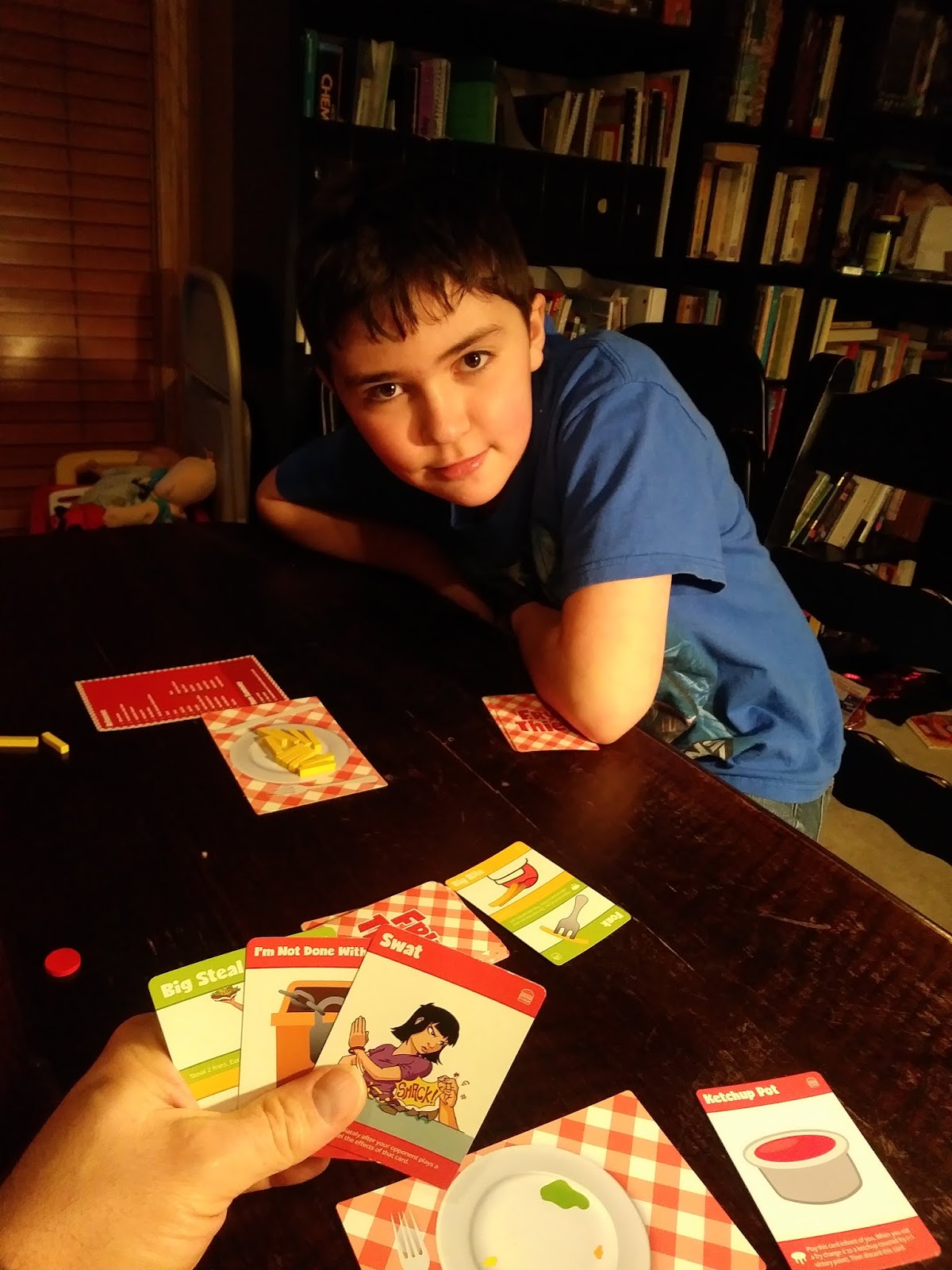
Playing Fry Thief at Protospiel Milwaukee in December 2018 with the designer Patrick Rauland.
After playing about a dozen games, I've found that Fry Thief still holds up.  Right now it feels like it's balanced a bit too much in favor of the fry player (although I've won games playing both roles), however I've been talking with Patrick, the designer, and a few cards are still being tweaked in order to shift the balance a bit more in favor of the salad player.  The salad player really has an uphill battle, having to steal the fries first.  Given the right combination of cards at the start of the game the fry player can eat two or three fries on the first turn.  This removes a good portion of the potential points from the game very early on, making it even harder for the salad player to gain an advantage.  However, a few cards have been changed since I got my copy, tempering the fry player's strength a bit, and giving the salad player a few more opportunities to make bigger plays.  I think this will really keep the game exciting and balanced.
I've won every game I've played so far...  Just saying...  =)
Fry Thief plays in about 10 minutes, and it's pretty small, so you can take it out just about anywhere.  It has a small table presence, so it doesn't take up much room at all.  It's perfect for playing at lunch at your favorite fast food joint or local diner.  I've had a blast playing it, and my sons have even pulled it out to play on their own a few times (something they only occasionally do with my review games).  If you enjoy fast, tactical fillers, Fry Thief will be an excellent addition to your collection.  It's always a blast to play!

Be sure to check out Fry Thief on Kickstarter on February 5.  It's a great game that you can get for only $15!

Preliminary Rating: 7/10

This review is of a prototype game.  Components and rules are not final and are subject to change.


Did you like this review?  Show your support: Support me on Patreon! Also, click the heart at Board Game Links , like GJJ Games on Facebook , or follow on Twitter .  And be sure to check out my games on  Tabletop Generation.


GJJG Game Reviews are independent, unpaid reviews of games I, George Jaros, have played with my family and friends. Some of these games I own, some are owned by friends, some are borrowed, and some are print and play versions of games. Where applicable I will indicate if games have been played with kids or adults or a mix (Family Play). I won't go into extensive detail about how to play the game (there are plenty of other sources for that information and I'll occasionally link to those other sources), but I will give my impressions of the game and how my friends and family reacted to the game. Quick Reviews will only get a single rating of 1-10 (low-high) based on my first impressions of the game during my first few times playing. Hopefully I'll get more chances to play the game and will be able to give it a full review soon.

Eye on Kickstarter #58

Welcome to my Eye on Kickstarter series!  This series will highlight Kickstarter campaigns I am following that have recently launched (or I've recently discovered) because they have caught my interest.  Usually they'll catch my interest because they look like great games that I have either backed or would like to back (unfortunately budget doesn't allow me to back everything I'd like to).  But occasionally the campaigns caught my attention for other reasons.  Twice a month, on the 2nd and 4th Fridays, I'll make a new post in this series, highlighting the campaigns that have caught my attention since the last post.  In each post I'll highlight one campaign that has really grabbed my attention, followed by other campaigns I've backed or am interested in.  I'll also include links to any reviews I've done.  Comments are welcome, as are suggestions for new campaigns to check out!

You can also see my full Kickstarter Profile to see what I've backed or my old Eye on Kickstarter page that was too unwieldy to maintain.  Also, check out the 2018 Kickstarter Boardgame Projects geeklist over on Board Game Geek for a list of all the tabletop games of the year.
So, without further ado, here are the projects I'm currently watching as of the fourth Friday of January, 2019:


HIGHLIGHTED CAMPAIGN
Gardens of Babylon
  • People Behind the Meeples Interview
  • Gardens of Babylon is a tile laying game where players build the famous hanging gardens and plant the flowers that made the gardens legendary. It has some interesting mechanics that sets this apart from your usual tile laying games.


King Nebuchadnezzar II has spoken: "Build me the most wondrous gardens the world has ever seen!" The gardening guilds of Babylon have answered, and it is now up to the players, as leaders of these guilds, to build one of the seven wonders of the ancient world and lead their guild to victory in the cutthroat world of competitive gardening.

Gardens of Babylon is a 1-4 player, competitive euro-style game in which players strive to earn the most points by planting flower seeds on the most valuable tiles. Taking turns, players place tiles to create a maze-like ziggurat of pathways, strategically move their gardeners to gain positional advantage, and plant seeds to claim tiles, earning victory points and triggering cascades down connected waterways to steal those of their opponents in the process!

Featuring simple rules and strategic thinking, Gardens of Babylon offers infinite replayability with 78 distinct ziggurat tiles that form a unique 2.5-dimension modular board. A novel cascade mechanism allows a well-placed seed to change the course of the game in an instant, offering emergent gameplay and keeping players on their toes until the very end.


Dracula's Feast: New Blood


Tangled Timelines
  • People Behind the Meeples Interview
  • This is a fast playing card game about time travel. It is a simple set collection game where you are trying to complete heroes' timelines before the deck runs out. Essentially it's a slightly modified version of Lamarckian Poker.


The Clowdus Collection
  • This is a collection of remastered games by designer John Clowdus, including Neolithic, Keep, and Merchants of Muziris. All three have decent ratings on BGG and these new editions look great!


NewSpeak
  • I received Newspeak to review a week before the first campaign launched, so I didn't have a chance to review it then. Since then the game has changed a bit and I was never sent updates, so I won't be reviewing it, but I can give my impressions of the original version I played. Newspeak wasn't a hit with everyone I played with - it's a lot more social than my usual group likes (they're into heavier strategy and euro style games), but it's definitely an interesting game if you like social brain burners. Newspeak is a social game with teeth. Fans of games like Spyfall, Mysterium, Codenames, Decrypto, and Dixit who want something just a bit deeper will love this. You really need to think on your feet, regardless of if you're on the side of the Mods or Dissidents. Newspeak will have you talking, laughing, and thinking creatively.


Suburbia: Collector's Edition
  • This edition of Suburbia comes with gorgeous new artwork, a tower to pull tiles from, and all the expansions and promos, plus a new expansion. If you like Suburbia this is a great way to get everything!


Vindication
  • This is an intriguing game that incorporates resource management, area control, tableau building, and more in what looks like an exciting race to build the strongest character before the game ends. However you don't know exactly when the game will end because the end game triggers change throughout the game.


Valor & Villainy: Minions of Mordak
  • In this RPG style board game you can either play as the villain or as part of a group of heroes set out to stop the evil wizard from destroying the world. This is being published by Skybound Games and Druid City Games, so you know it's going to have incredible production value.


Citizen
  • This is an interesting, and ambitious political game that uses actual historical and contemporary politicians' voting records, policies, and stance on various issues to let you shape America. Even though it's a political game it doesn't press any agenda, other than driving an interest in the political machine, landscape, and history.


Head Chef
  • People Behind the Meeples Interview
  • Head Chef is a fast playing action selection game about cooking recipes to gain fame. Tons of characters and recipes means tons of replayability!

Tuesday, January 22, 2019

People Behind the Meeples - Episode 155: Samuel W. Bailey

Welcome to People Behind the Meeples, a series of interviews with indie game designers.  Here you'll find out more than you ever wanted to know about the people who make the best games that you may or may not have heard of before.  If you'd like to be featured, head over to http://gjjgames.blogspot.com/p/game-designer-interview-questionnaire.html and fill out the questionnaire! You can find all the interviews here: People Behind the Meeples. Support me on Patreon!


Name:Samuel W. Bailey
Location:Washington State
Day Job:Freelance Game Designer
Designing:Five to ten years.
BGG:Samuel Bailey
Twitter:@Samuel_W_Bailey
Find my games at:Some of the stuff I did with FFG is still in stores. Others will be found through various publishers once they are printed and shipped!
Today's Interview is with:

Samuel W. Bailey
Interviewed on: 1/10/2019

Today's interview is with Samuel W. Bailey, a designer that you may have on your shelf. He's designed several games, including Forbidden Stars, as well as expansions to games like Talisman, Elder Sign, and XCOM. Samuel is active in a number of game design groups, so say hi if you cross comments with him!

Some Basics
Tell me a bit about yourself.

How long have you been designing tabletop games?
Five to ten years.

Why did you start designing tabletop games?
It’s one of the few things that I enjoy, am good at, and can make money doing!

What game or games are you currently working on?
Conan: Eternal Warfare for Shinobi 7. Lawyer Up for Rock Manor Games. Boarding House London, Masquerade Ball, Demolition City, and Dreamweavers are all prototypes I am still working on that need a home.

Have you designed any games that have been published?
Several, though Forbidden Stars is probably the most well known.

What is your day job?
Freelance Game Designer

Your Gaming Tastes
My readers would like to know more about you as a gamer.

Where do you prefer to play games?
My house or a friends house.

Who do you normally game with?
Friends and family

If you were to invite a few friends together for game night tonight, what games would you play?
Something I haven't played before, or a prototype that has been filling my brain.

And what snacks would you eat?
Chips and Hummus.

Do you like to have music playing while you play games? If so, what kind?
Not usually.

What’s your favorite FLGS?
Best Buds Gaming Bar and Pair o' Dice Games

What is your current favorite game? Least favorite that you still enjoy? Worst game you ever played?
Spirit Island is my current favorite. I am a bit over hidden identity games like Avalon or Secret Hitler, but still enjoy them. Worst game is https://boardgamegeek.com/boardgame/4845/star-wars-escape-death-star-game

What is your favorite game mechanic? How about your least favorite?
I really enjoy deck building as a mechanic. I don't have a solid least favorite, as I think most all game mechanics have their place somewhere.

What’s your favorite game that you just can’t ever seem to get to the table?
Twilight Imperium

What styles of games do you play?
I like to play Board Games, Card Games, Miniatures Games, RPG Games, Video Games, Other Games?

Do you design different styles of games than what you play?
I like to design Board Games, Card Games, Miniatures Games, RPG Games, Video Games, Other Games?

OK, here's a pretty polarizing game. Do you like and play Cards Against Humanity?
Yes

You as a Designer
OK, now the bit that sets you apart from the typical gamer. Let's find out about you as a game designer.

When you design games, do you come up with a theme first and build the mechanics around that? Or do you come up with mechanics and then add a theme? Or something else?
They usually need to go hand in hand. Theme informs mechanics, and mechanics inform theme. As development happens, both mechanics and theme can change though.

Have you ever entered or won a game design competition?
Nope.

Do you have a current favorite game designer or idol?
I don't really fan out.

Where or when or how do you get your inspiration or come up with your best ideas?
Usually when I am falling asleep, but sometimes even from my dreams!

How do you go about playtesting your games?
My wife first, then friends, then taking it to game nights.

Do you like to work alone or as part of a team? Co-designers, artists, etc.?
Usually by myself these days, though I enjoy co-designing.

What do you feel is your biggest challenge as a game designer?
Maintaining focus when I get stuck in the process.

If you could design a game within any IP, what would it be?
Dune or the Commonwealth Saga

What do you wish someone had told you a long time ago about designing games?
That the best thing you can do to be a game designer is to just start designing your own games. I waited 10 years before I thought I was "ready" when I could have just started going a lot sooner.

What advice would you like to share about designing games?
Game design is about constant failure, so don't feel discouraged. Just make a new iteration and try again!

Would you like to tell my readers what games you're working on and how far along they are?
Published games, I have: Forbidden Stars, Talisman: Cataclysm + Woodlands + Firelands + Harbinger, Elder Sign: Gates of Arkham + Omens of Ice, XCOM: Evolution, Relic: Halls of Terra
Games that will soon be published are: Rambo the Board Game, Lawyer Up, Conan: Eternal Warfare
Currently looking for a publisher I have: Boarding House: London, Masquerade Ball, Dreamweavers, Demolition City
I'm planning to crowdfund: Lawyer Up, Conan: Eternal Warfare
Games I feel are in the final development and tweaking stage are: Everything, it never stops until its published! But mainly Dreamweavers and Lawyer Up
Games that I'm playtesting are: Deep, Conan: Eternal Warfare
Games that are in the early stages of development and beta testing are: Bastions of Earth, Journeys in Steam, Primordial
And games that are still in the very early idea phase are: So many. I have idea files for about 30 games, 5 that I could turn into prototypes pretty easily.

Are you a member of any Facebook or other design groups? (Game Maker’s Lab, Card and Board Game Developers Guild, etc.)
As many as I can, including Game Maker's Lab, Card and Board Game Developers Guild.

And the oddly personal, but harmless stuff…
OK, enough of the game stuff, let's find out what really makes you tick! These are the questions that I’m sure are on everyone’s minds!

Star Trek or Star Wars? Coke or Pepsi? VHS or Betamax?
Star Trek, Coke Zero, VHS

What hobbies do you have besides tabletop games?
Larping!

What is something you learned in the last week?
That the ruins of Pompeii contain ancient graffiti with your mom jokes and graphic sexual phrases.

Favorite type of music? Books? Movies?
Chillstep, history/fantasy/sci-fi, good ones.

What was the last book you read?
On Writing by Stephen King

Do you play any musical instruments?
No, but I wish I did.

Tell us something about yourself that you think might surprise people.
I haven’t thrown up in 20 years.

Tell us about something crazy that you once did.
Decided to try and climb an oceanside cliff without ropes. Part of the cliff weakened by moss gave way and I almost fell 30 feet onto wave swept rocks. Took me 20 minutes to slowly pull myself up. Maybe more stupid than crazy!

Who is your idol?
I don't do idols.

What would you do if you had a time machine?
Go everywhen. Take pictures.

Are you an extrovert or introvert?
Ambivert. Its a real thing!

If you could be any superhero, which one would you be?
My own. With shapeshifting, time manipulation, and super speed. So like Flash and Mystiques baby.

Have any pets?
None currently, but I want a kitten.

When the next asteroid hits Earth, causing the Yellowstone caldera to explode, California to fall into the ocean, the sea levels to rise, and the next ice age to set in, what current games or other pastimes do you think (or hope) will survive into the next era of human civilization? What do you hope is underneath that asteroid to be wiped out of the human consciousness forever?
Classic games like chess, checkers, and especially go will live on. Their rules are well known and the pieces and boards are easy to recreate with basic elements. Sure would be nice if bigotry of all kinds would be wiped out by a big asteroid.

If you’d like to send a shout out to anyone, anyone at all, here’s your chance (I can’t guarantee they’ll read this though):
Thanks, Mom!

Just a Bit More
Thanks for answering all my crazy questions! Is there anything else you'd like to tell my readers?

Be awesome to each other, and play lots of games!

EXTRA ---

Arma virumque canō, Trōiae quī prīmus ab ōrīs Ītaliam, fātō profugus, Lāvīniaque vēnit


Thank you for reading this People Behind the Meeples indie game designer interview! You can find all the interviews here: People Behind the Meeples and if you'd like to be featured yourself, you can fill out the questionnaire here: http://gjjgames.blogspot.com/p/game-designer-interview-questionnaire.html

Did you like this interview?  Pleasse show your support: Support me on Patreon! Or click the heart at Board Game Links , like GJJ Games on Facebook , or follow on Twitter .  And be sure to check out my games on  Tabletop Generation.

Saturday, January 19, 2019

GJJ Games Reivew - Rise of Tribes - By Breaking Games

Rise of Tribes
Designed By: Brad Brooks
Published By: Breaking Games
2-4p | 30-60m | 10+
GJJ Games Reivew - Rise of Tribes - By Breaking Games
Disclaimer Support me on Patreon!

Game Overview:
Ever since I was introduced to the old Avalon Hill Civilization game back in high school I've had a love of civilization style games.  I spent hours and hours playing various versions of Sid Meier's Civilization throughout high school and college and still enjoy any games that have a tech tree and the ability to develop a nation.  Many of these games are 4x style games (eXplore, eXpand, eXploit, eXterminate) and take quite a while to play, so they don't hit the table very often.  So when a 4x style game that plays in under an hour comes along I'm usually pretty excited.

Rise of Tribes is more of a pre-civilization building, light 4x style game that plays in about an hour for 2-4 players.  It doesn't have a tech tree, but you can complete developments that give your tribe new technology and abilities.  In Rise of Tribes each player manages a tribe during the dawn of civilization in a race to be the first tribe to collect 15 points.  The game features gorgeous artwork, simple rules, fast play time, and a super interesting dice allocation mechanic.  Does it scratch the itch for a 4x civilization building game in just an hour though?  Or does it fall flat?  Let's find out.

Components & Packaging:
The first thing you'll notice when you open Rise of Tribes is the gorgeous insert and beautiful components.  The artwork in the game is absolutely fantastic.  The tiles are nice and thick, cards are good quality, and the wood tokens are good quality.  Each player's meeples are a unique shape, so you get a sense of individuality with your tribe.  I think the only thing I'm not wild about are the resource tokens.  They're very small cardboard bits that I may replace with nicer bits someday.  But overall the components are excellent.  There is a deluxe upgrade kit available for about $20 that will upgrade your resource tokens to wooden bits and add wooden tokens for the villages, mammoth, sabertooth tiger, and more.  These look great and are currently in my wishlist.
The artwork throughout Rise of Tribes is absolutely gorgeous!

Every tribe has its own meeple shape.  The component quality is outstanding.
The insert for the game is one of the nicest I've seen recently.  There's a spot for everything!  There's even a nice full color cardboard inlay with more of the gorgeous artwork that separates the smaller bits from the larger bits and a removable tray that stores the dice and advanced game components underneath.
Rise of Tribes has one of the best inserts I've seen in a game. 
Everything has its own spot in this multi-layered insert.
Score: 9/10 x1

Rules & Setup:
Setup for Rise of Tribes is quick and easy.  First set up the map by placing the hex tiles in a pre-determined arrangement.  There are a few different map layouts depending on the player count.  Then give each player a set of components in their chosen color (including cards, meeples, and a score tracker).  Next, each player chooses a tribe for their player board.  In the base game these tribes are identical except for the specific combination of resources needed to build a village.  In the advanced game each tribe has special abilities that may be used during the game.
Depending on the number of players you'll use a different number of water, forest, and mountain tiles to build your map.
Then you set out the game board with three dice in each action area, showing a Sun, Moon, and Blank.  The remaining two dice will go to the first player.  Shuffle all the event tiles (except for Chieftain and Abandoned Village) and place them in a stack.Place all the resources near the playing area and all the village tokens in a pile with the numbered side down.  All players then take a village token and the player with the lowest number is the first player.  Then, each player places starting tribe members on the map.  Depending on your place in the turn order you may get more members to place or some starting resources.
The action board is the strategic core of the game and setup is a cinch!
Playing Rise of Tribes is very straight forward.  There are five simple steps in each turn and you won't take most of them every turn.  First you'll score a point for every village you have on the board.  You'll skip this for the first couple of rounds (or maybe the whole game) since you won't have a village immediately.  Next you'll roll two dice.  Third you'll assign the dice to one each of four actions and then take that action.  Then you'll resolve any conflicts that are created, and finally you'll have the opportunity to build villages and complete any goals you have in progress.  The meat of the game is the actions that you'll take, but they're all pretty simple.
Each tribe board has a rundown of your turn, prompts for where to keep your goal cards, the cost of a village for your tribe, and beautiful artwork.
Before you take any actions though, you must roll the two dice that were displaced on the previous player's turn.  If you happen to roll doubles you'll trigger an event.  Events result in a variety of things happening.  Most are ongoing events that remain active until something happens to clear them out.  A few are one-time, immediate events.  There can only be two active events at a time, so if doubles are rolled and there are already two events active you won't gain a third event.  However, many of the ongoing events do something when doubles are rolled.  The events have a wide range of effects, from giving tribes additional resources when the take certain actions, to giving special abilities (like giving your villages Walls, or using a Dugout Canoe), and more.  There are even mammoths, saber tooth tigers, and volcanoes you may need to deal with.
Events are explained on nice, thick tiles.
The four actions that you can take are Grow (increase your population), Move (move tribe members around the map), Gather (gain resources), and Lead (gain Goal cards that you can work toward).  Each action has a standard, strong, and weak ability depending on what dice symbols are shown on that action's area on the gameboard.  Each action has space for three dice.  After you roll the two dice you have you'll assign one to the left side of each action you wish to take, pushing the rightmost die off of the action.  If there are at least two Sun symbols in the three remaining dice you'll get the strong ability.  If there are at least two Moon symbols you'll get the weak ability.  For anything else you'll get the standard ability.
Choose your actions carefully.  The dice you place will also be used by the players after you.
With Grow you'll be able to add 2, 3, or 4 tribe members to the board into areas that you occupy.  You don't need to control the areas, and you can peacefully coexist with other tribes, as long as the total population on a space doesn't exceed five units total.  With Move you'll be able to move up to 2, 4, or 6 units one space each.  You can't move a single unit more than one space (unless you have certain developments), but you can move multiple units into a space, even to exceed the 5 unit limit (that'll result in conflict in step 4 of your turn).  For the Gather action you'll be able to collect resources from spaces that you occupy.  You'll be able to gather either 1 or 2 resources from either 2 or 3 spaces depending on the symbol combinations.  Each space is a type of terrain and produces a different resource: lakes produce food (fish), forests produce wood, and mountains produce stone.
Each action has a standard, strong, and weak ability that you'll get to use based on the combination of dice.
Lead will get you 1, 2, or 3 goal cards from your deck.  There are two types of goal cards: Achievements and Developments.  Each will help you gain points.  Achievements give you more points, but require you to fulfill certain objectives, like controlling three spaces of a particular terrain, gathering a certain number of resources in a turn, or having your entire tribe (20 units) out on the board.  Developments are completed by spending resources.  They only give you one point, but give you special abilities.  Many of them make the actions stronger (for example, Pottery lets you grow by an additional two tribe members any time you grow, Basket lets you gather additional resources, and the Horse lets your units move two spaces instead of one).  Some give you other advantages (Bow gives you an advantage when you initiate a conflict).
Developments cost resources and give you game changing abilities.  Achievements reward your tribe for milestones.
After you've taken all your actions it's time to resolve conflict.  Conflict occurs in any space that has more than five units.  It doesn't matter what tribe they are from, so even if a space contains six units from one tribe there will still be combat.  Conflict is very simple to resolve.  Simultaneously every tribe with units on the contested space will remove one unit.  This repeats until only one tribe has units on the space (even if the total units falls below the five unit threshold).  If no tribe has more units than any other tribe it is possible for conflict to completely wipe out all units on a hex.  If a tribe had a village on a hex and that tribe is removed from the hex they'll lose their village (it doesn't get conquered).  There are two ways that conflict can be modified.  If you have the Bow development and you initiate the conflict (i.e. you are the active player), you'll get to remove one opponent unit before resolving conflict.  If you have both a village on the space and have the Walls event ability, then you'll also get to remove an opponent unit, but only when defending (i.e. you're not the active player).
With more than five units, this mountain will end up in conflict.
Everyone removes units simultaneously until there is only one tribe's units left.
After conflict is resolved, if you have the necessary resources or achievement you can build a village and complete goal cards.  Villages cost six resources, but which specific resources varies depending on the tribe.  Once you've finished building villages and completing goals it's the next player's turn.
Time to move on to the next player's turn!
The game ends immediately when someone gets at least 15 points.  You don't complete the round (which is why each player starts with a different number of units and resources), so it's important to really watch what others are capable of doing.  This is a light 4x style game, but it's also a racing game.  You must advance your tribe as fast as you can of you'll be left in the dust.
A balanced strategy is important.  You must complete Developments and Achievements to score points.
Once you've played the base game a few times there are several advanced features you can add to the game, either separately or together.  There are a number of special terrain tiles that have various effects and give certain abilities.  One or more of these can replace some of the standard tiles used in the game.  There are also unique tribal abilities that can be used to make the game a bit more asymmetrical.  Each tribe has two possible special abilities and you'll choose one of them to use during the game.  Tribal elders can be used to trade resources to opponents for use of their developments.  Each of these modules adds some additional complexity, but not a whole lot.  It's enough to keep the game fresh and add quite a bit of variety to the gameplay.
One of the advanced modules is new terrain pieces, each with its own beautiful artwork.
There are a few events that are a tiny bit ambiguous, however there is a section at the back that describes the events in a bit more detail than just the tiles.  This covers pretty much every scenario we cam across.
Even with just two players the game is great!
Score: 9/10 x2

Gameplay:
Rise of Tribes plays very smoothly and quickly.  It's simple enough to teach and players pick it up very quickly.  I love the theme and the artwork gives it a great table presence.

Because there are dice in the game there is a fair amount of luck.  However, since you are only adding your dice to two dice that are already at each action location, you are able to mitigate some bad rolls.  In fact, sometimes it's good to get some bad rolls because the dice you place can affect your opponents as much as yourself.  If you have an action that already has Sun-Sun-Blank you may want to add a Moon die to that action.  You'll bump off the Blank, leaving you with two Suns so you get the strong version of the action, however you'll leave the next player with at least one Moon (and that second Sun will get pushed off the next time the action is used).  This adds a layer of strategy that really takes a playthrough, or at least a few turns, before it sinks in.  A lot of bad rolls can hurt your game a bit (I played a game where I only rolled two Suns in the entire game and felt like I was playing catch-up most of the game - I only lost by 3 points in the end though), but it's almost self balancing because your poor rolls affect the other players and their good rolls can help you out.
The game looks gorgeous on the table.
Another feature of the game to be aware of is that it can be pretty swingy.  Often someone will be able to have a pretty big turn and gain six or seven points in one turn.  Since the game is really a race to 15 points, a seven point jump is huge and often ends up in a win, however it is possible to catch up to someone who jumps ahead if it happens with a few turns remaining in the game (e.g. a jump from three to ten points).  If you're not careful, and not expecting that, it can feel a bit deflating though.
This is a racing game as much as it is a 4x or civilization game.  Sometimes someone is able to race ahead.
In our first game someone managed a seven point jump from 7 to 14 in one turn and then ended the game on his next turn, with second place a distant 11.  It kind of left a bad feeling around the table, however we recognized that we did have opportunities to prevent the big jump if we had been paying closer attention.  Sometimes, however, a big turn can happen from Goal cards that were just drawn.  This can feel a bit more driven by luck, but if you are aware of the possible swinginess, and accept it as just part of the game, I don't think it's a problem.  As I've played more I've grown more accustomed to it and actually try to make planning a big play like that part of my strategy.  Sometimes it comes down to whoever can secure that big play first.  It helps keep the game tight and really enhances the race aspect of the game.
The game moves quickly and if you take your time you'll get left behind.
This isn't a 4x, civ building game that you can bide your time with.  Often times there is a player that jumps out in the lead, and it's often hard to catch a runaway leader (though not impossible).  You need to act quickly and be flexible, and sometimes collaborate with opponents to prevent someone from pulling too far ahead (it's not quite a bash-the-leader game, but you can team up to slow a leader down a bit), and I love that in this game.

Score: 8/10 x3

Replayability:
I originally had the Replayability score a bit lower because I wasn't sure I'd stay interested, especially with the swinginess of the game.  However, as I've played more I've really grown to love the game.  With experienced players you can knock out a game in under an hour and it gets tense pretty quickly. It's great to scratch that 4x itch without dragging out a 4+ hour behemoth.
I love that I can play a game in about 45 minutes.
I've played the game at all player counts and it plays well at two, three, and four players.  I think I like it best at four, but I quite enjoyed the game every time I played.

With the advanced modules that you can add and mix-n-match, there's a lot of opportunity for changing up the feel of the game.  I've even found some alternative map layouts online that look like they could be very interesting to play.
Tribe abilities just adds to the replayability.
Score: 9/10 x1

General Fun:
I have really enjoyed every game of Rise of Tribes I played, even the swingy games (not all have been swingy; some of the games have been very close).    It has just enough depth to remain interesting, yet is simple enough to remain on the casual side of gaming.  I really enjoy a number of aspects of the game, from the obviously great theme and artwork, to the more subtle aspects of the game, like the interplay between placing dice to help you now vs placing dice to hinder your opponents on their turns.  The game initially feels like an area control game, but once it clicks that players can share spaces on the map the game becomes much more about developing your tribe while preventing your opponent from running too far ahead.  There are wonderful interactions that at first seem unrelated.  All aspects of the game are critical and important, which makes the decisions very fun and sometimes pretty challenging.
The game moves at a brisk pace, keeping things exciting right from the first round all the way to the end.
Score: 9/10 x2

Overall Value:
You get a lot in this game for $50.  The components are excellent and the wide range of gamer types that this will appeal to means you'll probably be able to get this to the table pretty regularly.  It's simple enough for newer gamers, but plenty deep enough for experienced gamers.  Plus, it'll scratch that 4x itch in 45-60 minutes instead of 4-6 hours!
There is a TON of game, both components wise and gameplay wise, packed into this box.
Score: 8/10 x1

Final Thoughts:
Rise of Tribes was one of my favorite games of 2018.  I think the only thing that I'm not sure how I feel about it is the swinginess.  For newer players it can feel like a big defeat when someone jumps seven points in one turn, leaving everyone else in the dust.  That's a feature of the game that can be mitigated though, and it doesn't turn up in every game.  Once you're familiar with the game, those jumps are something that you can strategically plan for, and they're quite fun when you achieve them, so I guess in the end I like how they affect the game.  They definitely help the game move quickly to its conclusion though.
I can't imagine anyone not enjoying Rise of Tribes.  Everything about the game works really well. 
You'll love having it in your collection!
If you enjoy 4x style games but don't have the time to invest in a four hour game there are only a few really good options that play in an hour or so, and even less that play even faster.  Rise of Tribes is a very strong contender in this niche and will be hitting my table as often as I can.  I can play two games of Rise of Tribes in an evening and still have time for other games, instead of spending four hours playing a single game.  That's a winner any day in my book!

Overall Score: 86/100


Did you like this review?  Show your support: Support me on Patreon! Also, click the heart at Board Game Links , like GJJ Games on Facebook , or follow on Twitter .  And be sure to check out my games on  Tabletop Generation.


GJJG Game Reviews are independent, unpaid reviews of games I, George Jaros, have played with my family and friends.  Some of these games I own, some are owned by friends, some are borrowed, and some are print and play versions of games.  Where applicable I will indicate if games have been played with kids or adults or a mix (Family Play).  I won't go into extensive detail about how to play the game (there are plenty of other sources for that information and I'll occasionally link to those other sources), but I will give my impressions of the game and how my friends and family reacted to the game.  A score of 1-10 (low-high) is given to each game in six categories: Components & Packaging, Rules & Setup, Gameplay, Replayability, Overall Value, and General Fun.  Rules & Setup and General Fun are weighted double and Gameplay is weighted triple.  Educational games have an extra category and Gameplay is only weighted double. Then the game is given a total score of x/100.