Friday, October 30, 2015

Quick Review - Creepiest Pet Shop - Kickstarter Preview

Creepiest Pet Shop
Designer: Levi Bushue
Publisher: Creepy Tiki Games
Quick Review - Creepiest Pet Shop - Kickstarter Preview
Disclaimer

I like creepy stuff.  I always have.  Even when I was little and afraid of haunted houses and scary movies I still had a fascination with creepy stuff.  So when Levi Bushue contacted me and asked if I'd review his Creepiest Pet Shop game I said sure!  A few days later I got a small box in the mail with my very own Creepiest Pet Shop decks.  And with Halloween right around the corner it's the perfect time to play a game packed with the monstrous denizens of the world that just want to give a not-so-adorable critter a happy home.

Creepiest Pet Shop is a quick playing matching and trick taking speed game for 2-6 players.  It's currently on Kickstarter for $19 through November 21, 2015.  So if you're interested in the game, be sure to check it out here: http://kck.st/1OKMeN0
There are two types of cards in Creepiest Pet Shop.
Pets and Monsters.

Overview:
Let me start my review by saying that Creepiest Pet Shop isn't the usual type of game that I play.  Generally I like games with more strategy and depth.  But sometimes you just want a fast playing, ruckus raising, fun filler.  And Creepiest Pet Shop is definitely targeting that audience.
The quick play is great for families and friends!

In Creepiest Pet Shop the premise is that there are a lot of creepy pets that need to be adopted by their equally creepy new masters.  There are two decks of cards, one for creepy pets, and one for creepy monsters.  The goal is to be the fastest player to match their monsters with compatible pets.

Gameplay:
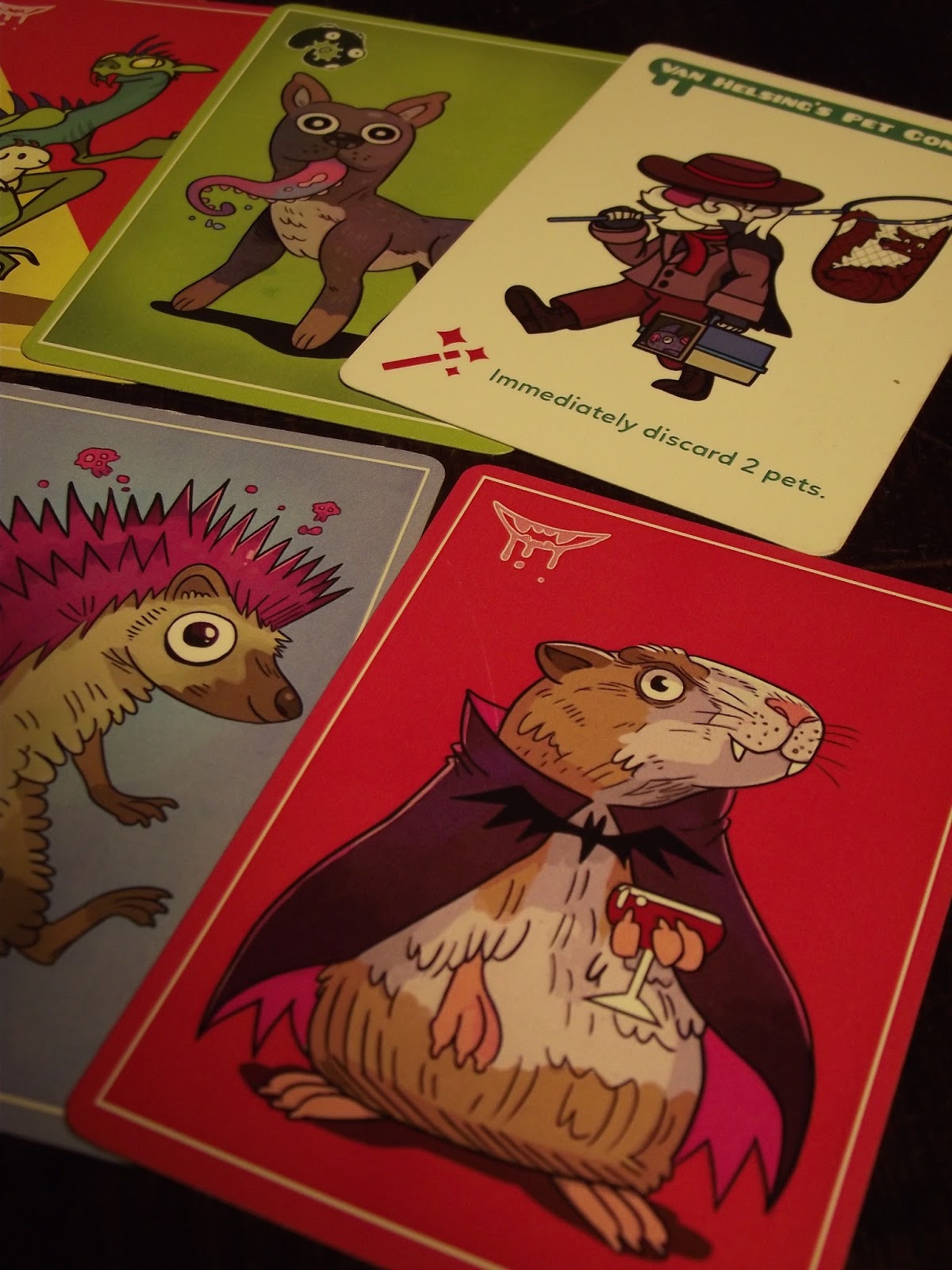
The game is played in rounds, each round consisting of 3 phases.  In Phase 1 players can discard up to three monster cards and draw back up to their hand limit, which is generally five cards, but can be more or less depending on some cards' effects.  Once players have a full hand of monsters they can play any effect cards they have.  Effects can be beneficial or harmful.  Generally you'll want to play beneficial effects on yourself and harmful effects on other players.  Some effects cards may increase your hand limit by two, allow you to adopt any pet with any monster, or adopt a free pet.  Other effects may decrease your hand limit by two, or lose pets to Van Helsing's Pet Control.
Poised to adopt some pets!

After all effects have been played and resolved comes the main part of the game, the pet adoptions.  The last player who adopted a pet in the previous round is in charge of the pet deck.  They draw two pets from the pet deck and then reveal them to everyone simultaneously (a countdown is a good idea).  Then everyone races to adopt the pets!

Adopting pets is very straight forward.  Each monster has a color and symbol.  Each pet also has a color and symbol.  Playing a monster that matches a pet means the monster adopts the pet.  The quickest player to play a match makes the adoption.  Some pets have two colors/symbols.  This means they have to be adopted by two monsters (maybe they're cohabitating...).  Some monsters (ferocious monsters) also have two colors/symbols.  These can be used to adopt pets that have one or both matching symbols.  Ferocious monsters can also be discarded to remove a lingering effect from someone.  There is also a wild card that can be used as any symbol/color to adopt, or help adopt any pet.
Ready...  Set...

Adopt!

Once both pets have been adopted the monsters used to adopt them are discarded and the pets are kept as points (one point for a single color pet and two for a pet with two colors).  Then a new round starts.  The game ends when the pet deck is emptied and all the creepy pets have been adopted by creepy owners.

Reception:
I said that Creepiest Pet Shop isn't really my usual type of game.  So I felt it was important to play it with people who do enjoy that type of game.  I brought it with to the Family Game Night that I host at my FLGS and played it with adults and kids.  Everyone had a blast with it and said they really liked it.  I'm still not a fan of speed matching type games (I reluctantly play Spot It with my son when he insists, and that's about my limit), but I did have fun playing.  I got destroyed.  I guess I thought too much (Terra Mystica is more up my alley).  The only pet I managed to adopt got stolen by Van Helsing's Pet Control.  That game ended up being only a one point difference between a six year old and his dad.  So if you're fast enough the game is good for pretty much all ages.
Fun for adults and kids alike!

In the six player game I played we did seem to be running out of monsters, but it looks like the final game will have about 33% more cards, so that's good.  There will also be a number of exclusive and promotional cards included with the Kickstarter version.  And with the Kickstarter version you also have the opportunity to grab a limited edition copy on larger tarot sized cards with fancy borders.

Everyone, myself included, really liked the artwork.  The characters are fun and interesting to look at.  I love all the nods to pop culture monsters (Cthulhu with kittens is awesome).  I only have two minor complaints about the artwork and graphics.  I wish is that the monsters and pets were more easily distinguished on the front.  It's a minor issue, but once pets are adopted and start to get mixed in with the monsters it's difficult to tell at a glance what kind of card it is.  Yes, the pets look petlike and the monsters are more humanoid, but the hole layout and design of the cards is identical, making it difficult to tell at a glance.  I also wish the monster faction symbols were a bit larger on both the monsters and pets.  They're pretty small up in the top right corner, making is a bit challenging to see quickly while they're in your hand or on the table.  These are both minor issues though and don't really affect the gameplay.
Cat-thulhu?

Adorable, creepy pets.  Wouldn't you want to bring one home?

Yes, even monsters need companionship.
Final Thoughts:
So, after playing, this still isn't really my type of game.  Yes I had fun, but I would have rather been playing something else.  So I probably won't be keeping the game.  The good news is, I have someone that will really like to have it!  The others I played the game with really like speed games like this and they thought it was great.  So my friend Ryan and his family (they have four kids, so it'll be a fun game for them) is going to get a little gift =)
I'm sure they'll keep the game.  It's not a
cat with a sentient tongue...

So, is this something I'd back?  No.  It's not my cup of tea.  Ok, maybe it is my cup of tea, 'cause I don't like tea.  But, like tea, I'll drink it if there's nothing else.  I did have fun playing and it was very well received by everyone else.  They talked about it for quite a while after playing, even after we moved on to another game.  So while it's not for me, if you enjoy these types of games, Creepiest Pet Shop is a good one.  My rating below based on the fact that everyone I played with loved the game.

Be sure to check out Creepiest Pet Shop on Kickstarter now!  http://kck.st/1OKMeN0


Creepiest Pet Shop was a rousing good time!
Preliminary Rating: 6/10
This review is of a prototype game.  Components and rules are not final and are subject to change.


Did you like this review?  Show your support by clicking the heart at Board Game Links , liking GJJ Games on Facebook , or following on Twitter .  And be sure to check out my games on  Tabletop Generation.

GJJG Game Reviews are independent, unpaid reviews of games I, George Jaros, have played with my family and friends.  Some of these games I own, some are owned by friends, some are borrowed, and some are print and play versions of games.  Where applicable I will indicate if games have been played with kids or adults or a mix (Family Play).  I won't go into extensive detail about how to play the game (there are plenty of other sources for that information and I'll occasionally link to those other sources), but I will give my impressions of the game and how my friends and family reacted to the game.  Quick Reviews will only get a single rating of 1-10 (low-high) based on my first impressions of the game during my first few times playing.  Hopefully I'll get more chances to play the game and will be able to give it a full review soon.

Thursday, October 15, 2015

Quick Review - Pentoggle - Kickstarter Preview

Quick Review - Pentoggle - Kickstarter Preview
Disclaimer

Pentoggle
Designer: Douglas Jones
Publisher: Unpublished
Pentoggle (formerly Match 5) is an abstract tile matching game for 2-6 players, with a unique twist.  It is for ages 7 and up and plays in about 45 minutes, all of which I'd say is fairly accurate.  The game came to me a few weeks ago from Douglas Jones and is currently unpublished.  Although the rules were solid the prototype I received was obviously handmade and the game seems to be quite a ways from production.  But the game premise sounded interesting to me, so I agreed to review it.  I've been told that eventually it'll be on Kickstarter, but there is no definite schedule yet.  I'll update here when I have more information about production plans and pricing (I'd expect it to MSRP for about $35-$40).

Overview
At first glance Pentoggle's overview sounds very much like Qwirkle, except you're matching sets of 5 tiles instead of 6, and numbers/colors instead of shapes/colors.  Even the rules are very similar, sets can be the same color but different shapes numbers or the same shape number but different colors. Players have six five tiles in their hand and can play one or more to connect to or extend a set that has already been played. When a set of six five tiles is completed the player gets a bonus of six ten points.  After you've played your turn you draw tiles from a bag back up to a full hand.

Honestly, when I read the description of the game I wasn't expecting much more than Qwirkle.  And while Qwirkle is a family favorite, I didn't think I'd need something else that seemed like basically the same game.  But a few features of Pentoggle caught my attention and I agreed to review it.  Heck, if I liked Qwirkle this couldn't be all that different, could it?
Bright, colorful tiles are used in Pentoggle.

Gameplay
But it's the few differences in Pentoggle that really make it shine.  Whereas in Qwirkle the tiles are square where all four sides can be linked, in Pentoggle the tiles are hexagons where only three sides can be linked.  That might not seem like a huge deal, but it really adds quite a bit to the spatial organization that your mind has to figure out.  Oh, and did I say only three sides of the Pentoggle tiles could be linked?  Actually it's four sides.  That's right, the tops of the tiles can have other tiles stacked on them to create vertical sets that tower over the table!  This add a whole new dimension (pardon the pun) to tile matching games!
The game grows horizontally as well as vertically!
Scoring is also a bit different in Pentoggle than in Qwirkle.  Instead of each tile being worth one point, a la Qwirkle, each tile is worth points equal to the number printed on the tile.  This means a series of tiles can be worth anywhere from 5 to 25 points, plus a ten point bonus for the player that completes the series.  Just like in Qwirkle, when you add to a series you score not only for the tiles that you played, but also all tiles in the series they continue.  And when tiles are placed that connect multiple series the scores can get really wild!  Although most single turn scores average around 15 points, we've had single-turn scores reach into the 50s!
Every game creates its own little sculpture as it grows!
Also, unlike Qwirkle, once a player goes out, everyone else gets one final turn, then any tiles left in their hands is subtracted from their scores.  Although, in all the games I played, this only amounted to a few points lost for several players (many were also able to clear their hands in that last turn, too).  Final scores are usually in the 150-500 point range, depending on the number of players.
Here a 1 is played for 10 points.
Pentoggle also has Wild tiles, which can count as any number/color.  Wild tiles are worth zero points when played, but if you have any in your hand at the end of the game you'll lose 25 points.  This generally isn't an issue since you'll always get one turn after someone goes out, however if you get stuck with two in your hand when that happens you're out of luck since you can only play one Wild per turn.

The last bit that is different than Qwirkle is tile locking.  This is an interesting mechanic where, once a series is complete, the open horizontal sides on the first and last tiles in the series have small wooden cubes added to them to indicate that they can't be built onto any more.  If a series has already been started off the end tile of a series that is about to be completed, it can remain.  And vertical series can still be started off of the end tiles.  Tiles in the middle of a series can still be built onto. Once a vertical series is complete a lock cube is also added to the top of the stack to indicate that it is complete.  This makes the growing tile grid a bit more restrictive and means strategies need to be planned to take this locking into account.
Wild tiles and locking cubes add an interesting aspect to the game.
Components:
The components in Pentoggle are pretty standard for what you'd expect in this type of game.  I'm not sure what a final game would be since what I played was an obvious homemade prototype, but hopefully a production game would have very similar tiles.  They were made of large wooden hexagonal blocks, about 1/75" wide by .75" thick.  This is quite a bit bigger than Qwirkle tiles but I don't think they should be made much smaller in a production game.  The big tiles are nice to hold and are easy to see and stack.  Smaller tiles might make for a smaller bag and more portable game (e.g. Hive sized tiles), but since the numbers have to be written on the sides (to facilitate stacks and also indicate which sides can be connected) they can't really be any thinner and the breadth of the tiles makes them easy to read and stack.
The big blocks are great fun to play with.
The one thing that does need to be done better though is screens.  Since the tiles have their numbers and colors on the sides you can't stand them up and keep them hidden like in Qwirkle, so you need screens to make sure your opponents can't see your tiles.  The screens I got in the prototype were just half sheets of cardstock, which were pretty much useless.  A production game needs larger screens made of a sturdier chipboard material.  I'm sure any kind of production game would have better quality screens though.
The prototype screens need a little work, but they're functional.
Final Thoughts:
I really, really liked Pentoggle.  Before I played initially I didn't think it would bring enough different to the table to replace Qwirkle.  And after one play I had mixed feelings.  The scoring is more complex than Qwirkle since each tile is worth a different number of points and that ended up creating a very messy score sheet for the first game.  I created a column for each player and then used tally marks to keep score.  That was fine in the first few turns when scores were 2-15 points, but very quickly the scores turned into 30-50 point turns.  I made a TON of tally marks and spent most of the time scratching little lines on a piece of paper instead of focusing on what I could do on my turn.

On subsequent games I started grouping scores in groups of 10, 5, and 1 by using X, V, and tally marks.  So if a score was 39 points I'd put three Xs at the top of the player's column on the score sheet, a V in the middle, and four tally marks at the bottom.  Then if their next turn was 18 points I'd add another X to the top, another V in the middle, and three more tally marks at the bottom (turning the first four into a group of five and then adding two more).  This made tracking scores a whole lot quicker and made them easy to add up at the end of the game.
The first game I only used tally marks and quickly ran out of paper.
On my second game I got a better scoring method down.
Look at how high the scores get in a two player game!

Once I got over the issues with scoring and was able to focus on the actual game I started to really enjoy it.  Not that I didn't enjoy the first game, but later games were a ton more fun because I could focus on the game more (and I'm happy to say, win more, too).

I really, really like how everything isn't in a straight grid.  The hexagonal tiles make everything twist and zig-zag around.  And the vertical stacks really add a ton of interest and additional strategy to the game.  It looks incredible on a table while being played and really attracts attention, drawing in interested people.  And the crazy layouts mean the players have to be a bit active, too.  There are many times when you simply have to get up and move to the other side of the table to see how the tiles over there are laid out.
The game looks completely different depending on your perspective.
From the opposite side you can see a lot of other options.
This invites players to get up and move around.
Everyone I've played the game with has absolutely loved it.  I even played it back-to-back with Qwirkle (some of the people had played Qwirkle before, some hadn't, and no one had played Pentoggle before).  Everyone unanimously agreed that they enjoyed Pentoggle as much as or more than Qwirkle.  Qwirkle has won a number of awards, including the 2007 Mensa Select and 2011 Spiel des Jahres, so saying they preferred Pentoggle is quite an honor!
Is this the Qwirkle killer?  This group thought so!
The concepts are simple, but the strategy is much deeper than in Qwirkle.  You are constantly thinking things like, should I play my two fours to extend this series of fours, or should I only play a two, but the two can connect to two different series.  Or maybe I should play the two with this three and make it a part of that series over there.  Because each tile is worth a different amount of points and you score points for the entire connected series, where you place tiles matters a lot more in this game than they do in Qwirkle.  And deciding when to use a Wild tile is also an interesting decision.
Every game results in a work of art!
Though the scoring is a bit daunting at first, Pentoggle makes a great family game and teaches arithmetic in a fun, challenging way.  The game is easy enough for my six and nine year olds to play and helps strengthen their math skills along the way!  It's a perfect game for casual gamers (or deeply strategic gamers that occasionally like a lighter abstract), families, schools, and homeschools!
Your kids can learn while they play!
Another great feature of Pentoggle is that it doesn't use cards or light components, so it holds up against the wind!  One of the games I played was at a park, on a wire mesh picnic table, on a very windy day and the game held up fine!  A few of the square locking cubes blew off the stacks once or twice, but I'd expect a production game to use a denser wood than the craft store cubes this prototype came with.
Outside, in the wind, and the game played great!

So, would I recommend Pentoggle over Qwirkle?  Yes!  Would I recommend getting Pentoggle if you already have Qwirkle?  Possibly.  I'm still not sure it's different enough to kick Qwirkle out if you already have it, but if you are ok with having both, or don't have either yet, definitely consider Pentoggle over Qwirkle (if it ever hits retail, that is).
I can't wait to permanently add
Pentoggle to my collection! 
Unfortunately I have to send the prototype copy of Pentoggle back very soon.  It's obvious that a lot of time and love went into making the copy I got to play and I know Douglas wants to get the game into the hands of plenty of other reviewers.  But he's definitely won a fan here.  My wife is very,very disappointed that we have to send it back and can't wait until we can buy a production copy someday!  Hopefully that day will come soon!

Preliminary Rating: 8/10

This review is of a prototype game.  Components and rules are not final and are subject to change.


Did you like this review?  Show your support by clicking the heart at Board Game Links , liking GJJ Games on Facebook , or following on Twitter .  And be sure to check out my games on  Tabletop Generation.

GJJG Game Reviews are independent, unpaid reviews of games I, George Jaros, have played with my family and friends.  Some of these games I own, some are owned by friends, some are borrowed, and some are print and play versions of games.  Where applicable I will indicate if games have been played with kids or adults or a mix (Family Play).  I won't go into extensive detail about how to play the game (there are plenty of other sources for that information and I'll occasionally link to those other sources), but I will give my impressions of the game and how my friends and family reacted to the game.  Quick Reviews will only get a single rating of 1-10 (low-high) based on my first impressions of the game during my first few times playing.  Hopefully I'll get more chances to play the game and will be able to give it a full review soon.

Wednesday, September 23, 2015

Check out Creature College and a Giveaway!


Check out Creature College on Kickstarter now! http://kickstarter.happyottergames.com/

And be sure to enter my contest to win a copy of Machi Koro in celebration of the Creature College launch!  Enter on Facebook until 6:20pm tomorrow evening! https://www.facebook.com/GJJGames/posts/1824836594409460

Tuesday, September 15, 2015

Quick Review - The Guardians: Explore - Kickstarter Preview

The Guardians: Explore
Designer: Jonathon Ruland
Publisher: Jonathon Ruland
Quick Review - The Guardians: Explore - Kickstarter Preview
Disclaimer

A few weeks ago I received a copy of The Guardians: Explore to preview.  This is the first game by designer Jonathon Ruland and it is quite eye catching.  The Kickstarter just launched on Tuesday, September 15th and is available for $40.  Check out the campaign here: https://bit.ly/TheGuardiansX

In The Guardians: Explore the players are kids defending their home town, Arthursburg, from attacking monsters.  The game is played in two phases.  Initially there is a deck creation phase that consists of two seven-card drafts and a deck refinement step.  This is followed by the meat of the game where players battle monsters and build their decks with some more traditional deck-building mechanics.  But this isn't really a game about deck-building.  It's more about deck refinement.  You'll start the game with 17 cards in your deck, 10 of which you've chosen through the drafting process.  And then through the course of the game you'll actually want to strip down your deck even further, getting rid of the other 7 weaker cards that you start the game with and replacing them with stronger cards from the general pool.  But not just any cards will do.  There are some really tight interactions in the card types that you'll want to watch out for.
The heroes prepare to defend Arthursburg!
Anyway, if what I just mentioned sounds overwhelming, let me try to explain a bit more.  The game sounds confusing at first, and it's kind of difficult to explain, but once you get it figured out it's not too bad and really is an interesting way of acquiring and honing character skills.

Setup and Deck Creation Phase

There is a lot going on in this game and setup takes a little while.  There are several types of cards that need to be sorted, shuffled and arranged, boss monsters that need to be selected, locations need to be set out, and lots of bits distributed to the players.  If you keep everything well organized it should go pretty quickly, but there is a lot crammed into the little prototype box I received.  The pictures of the production box look bigger, so with decent inserts to keep components organized setup hopefully won't be too bad, especially after your first game or two.  I do wonder if the locations will remain cards in the final game since they seem like they could be placed on a game board.  In the prototype the ten locations are square cards that are arranged in the same order every time.  Maybe there are plans for additional locations in the future, but in the current version it just adds more pieces that need to be sorted and arranged (it looks like in a previous iteration of the game there were more locations to choose from, so maybe a stretch goal?).
There are a lot of components in this game.
Most are cards, but there's a lot packed
into the box!
Once all the components are set up each player starts on the first phase of the game, Deck Creation.  Each player will receive some basic cards (five Practice Swings and one Explore).  But unlike traditional deck-builders where each player begins the game with those same cards, in The Guardians: Explore there is a whole process to creating your custom starting deck.
The basic Practice Swing and Explore cards are pretty weak,
but don't trash them too early in the game without having
enough Attack and Energy producing cards to make
up for their small benefits.
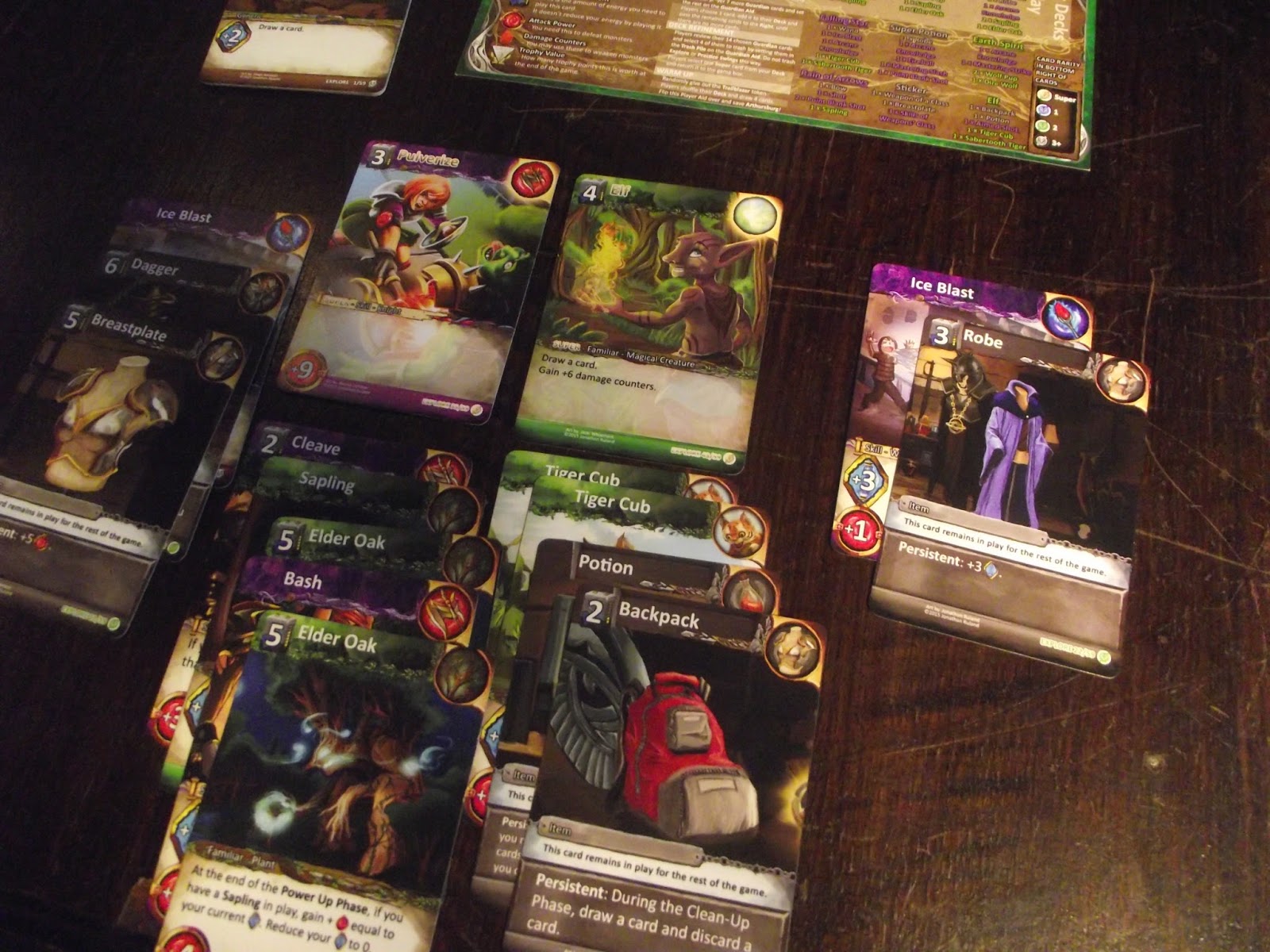
Each player will then be given two Super cards.  These are special abilities that your character will have, like Pulverize, which gives you 9 attack points right at the start, or the Eternal Elk, which lets you discard your entire deck then trash all the Practice Swing cards from your discard pile before shuffling it and making it your draw pile again.  These Super cards are very powerful and you'll draft your entire strategy around the cards you're dealt, but you'll only get to keep one of them.  Each player will also get two Secret Goals that award bonus points at the end of the game if they meet those goals AND the final boss monster is defeated, so knowing what these are may also affect how players create their decks.
The Drafting Suggestions are super helpful in figuring out
what card types work well together.
Once all players have their starting cards, a draft of additional cards will begin.  Each player will get seven cards from the general deck of Guardian cards.  These cards are various items, skills, and familiars (animal creatures that help out), from one of eleven different classes.  Each of these cards has various abilities and often interesting combinations with other cards of the same class.  Depending on which Super cards you received at the start you'll want to focus on collecting different types of cards during this draft.  But don't worry, the back of each player's mat includes a little cheat sheet that shows some recommended cards to get during the draft depending on what Super cards you have.  Once you've selected one card to keep from the seven you were dealt you'll then pass the remaining six cards to the left and you'll get six cards from the player on the right.  Choose another and pass the remaining five.  This will repeat until each player has seven cards drafted from all of the original decks.  Then each player will draw seven more cards and repeat the process again, this time passing to the right.
Starting out the drafting you'll have two Super Cards and have seven
Guardian cards to draft from.  Sometimes it'll be a difficult choice,
sometimes it'll be obvious what card to keep before passing the rest.
From the cards above I have three that will work out with my Super
cards from the first draft hand.  I'll take the Tiger Cub and hope I
can work on  bolstering the Elf Super card's abilities.
Well, after drafting 14 cards it turns out I have more that help
with the Pulverize Super card.
When all is said and done players will have 14 drafted cards, 2 Super cards, and 6 basic cards.  But they'll have one chance to refine their decks before starting on the Battle phase of the game.  Each player will have to trash (i.e. put into the main Guardian cards discard pile) four of the cards they just drafted and one of their Super cards.  So they'll end up with a starting deck of 17 cards that they will shuffle up.

Time to start refining the deck.  I'll get rid of the four cards that
support the Elf Super as well as that Super card.  Now I have to
hope Pulverize will help me smash monsters!
This looks like a pretty decent starting deck of 17 cards.
This entire deck creation and refinement process feels like a game unto itself.  The cards have some pretty intricate interactions and understanding them well will take some time.  The reference card telling what cards interact well with the various Super cards is indispensable, especially for newer players. Expect to end up frustrated often during your first few plays until you figure out how to draft a strong deck right from the start.

Battle Phase

Once each player has painstakingly created their starting deck they are ready to set out and defend Arthursburg from the invading zombies, orcs, robots, spiders, and warlocks.  There will be eight total Battle rounds in a standard game (four in an Apprentice game), with two of those rounds being battles against the Boss.  That doesn't give players much time to hone their skills by building and refining their decks, especially when they also need to be fighting monsters.  But again, the game's underlying strategy is a bit deceptive here.  The game isn't just about defeating monsters.  The game can technically be played without ever once battling a monster (although that's not a winning strategy).  Players earn points for defeating monsters, but in order to do so they need to keep refining their decks, weeding out weak cards and adding in stronger cards that hopefully complement other cards they already have in their decks.

Each Battle round has several steps.  Players will start with four cards from their deck (usually drawn after the previous round's Battle).  First each player gets to go to one of ten locations and take the action there.  The catch is they can only go to locations that are safe and not currently invaded by monsters.  Initially that will only be the Home location, but as monsters are defeated more choices will open up.  Some locations give extra attack strength, some give extra energy, some let you gain new cards or trash cards that don't fit in with your strategy, and some have some more unique abilities.
The town locations have been invaded by monsters!
The first round everyone goes to Home and gets a chance to
refine their deck just a little more.
Home lets me draw two cards, discard two cards, and then trash
up to two cards, which can help me get rid of some weaker cards.
I'll get rid of the two cards that won't help much this hand.  I'd have
enough energy to use the dagger, but at this point in the game I
think I'd rather have the 5 attack points that the Breastplate
will give me each turn.  I'd also like the Wolf Pup's ability to
draw an additional card as opposed to the practice swing's
extra attack since I'll already have 6 attack, which is
enough to kill one of the first Wave monsters.
After the players choose their location they will enter the Power Up step.  This is where players use the cards in their hand.  Cards have a number of different symbols on them that represent their faction, energy needed to use, energy produced, and attack strength produced.  Cards may also have additional ability text.  The sequence cards are played can be important because some generate energy while others require energy to be played.  Some will also let you do things like rearrange cards in your deck while others let you draw cards into your hand.  So you'll want to carefully consider all of these interactions while you play cards, keeping track of acquired attack points, damage counters, and energy produced.  This part happens between all players simultaneously so it goes pretty quickly, but it can get fiddly and difficult to track all the stats effectively, especially when some cards give you bonuses in later steps in the Battle phase depending on what monsters you attack.  There is a great tracker for managing attack points accrued, but this is definitely one of the least elegant parts of the game.
The hand played great for me!  The card I drew with the
Wolf Pup let me draw another two cards.  Now I have
two Persistent items that will give me benefits for the
rest of the game and I've reached 11 attack strength.
Time to go monster huntin'!
Once all players have finished the Power Up step there is a brief step where any  Surprise cards can be played.  These have special effects that can change other players' abilities for the round, give players an extra card, etc.  Then it is time to do battle.  In turn, each player distributes any damage counters they earned in the Power Up phase to any monsters in the city.  This can help weaken monsters so they're easier to kill later, or even completely kill a monster so the player can earn that trophy and still attack another location.  Killing monsters is pretty straight forward; they have a strength and if you deal enough damage to exceed that strength you defeat the monster.  Some locations have two monsters at them and you can defeat both if you have enough strength.  But you can only defend at a single location per turn.
11 Attack is enough to take on two monsters at the Hill!
After defeating any monsters at that location you can protect it by placing a Blanket Fort card there.  If you don't new monsters will invade that location.  Each player only has one Blanket Fort, so there will always be some locations that are unprotected.  Deciding where to put your Blanket Fort is sometimes a critical decision.  You can only keep it at its current location or move it to the location you successfully cleared of monsters, and whichever location you have the Blanket Fort at will be a safe location that players can go to during the next round's Location step.  So you really need to plan ahead here.  Finally there's a cleanup phase where players draw their next four cards, the time marker is advanced, and a few other bits.
The monsters are defeated and I'll move my Blanket Fort to the
hill to protect it from new invaders.  Now the Hill will be available
to use during the next round's Location step. 
Killed monsters go in my Trophy pile and are worth points
at the end of the game.
After three normal Battle rounds a Boss monster will arrive on the scene.  The Boss monsters are pretty horrendous.  When they appear they hurt all the players a bit.  Then they act as another location that players can go to and attack the monster.  But the Boss monsters are tough.  They'll generally have a pretty high base strength and then that is multiplied by the number of players.  The first Boss is generally around 12 strength per player and the second Boss is about 24 strength per player.  These are some rough and tumble bosses!  Play proceeds through the Location and Power Up steps of the Battle phase normally, but when attacking monsters players can choose to help defeat the Boss instead.  If the boss is defeated each player that contributed to its defeat earns a reward.  Those that didn't contribute don't get any rewards.  And if the Boss is not defeated everyone suffers a penalty.
The bosses are big baddies and must be defeated in a single round.
It's this part of the game that I think has the most issues.  It is not very easy to track how much every player has contributed to the Boss monster's defeat, and the boss battles just don't seem tense enough or particularly well balanced.  And while the strength and effects of the monsters vary, the rewards for defeating the monsters are all the same.  This is really the only part of the game that is cooperative and it doesn't really feel like players are cooperating much at all.  Instead, each player is simply allocating all of their attack strength to kill the Boss.  Because of this the last player has a distinct advantage.  The last player will always be able to see if the monster is going to be defeated or not.  So it's easy for them to make the decision to help out or not.  And since the Boss monster will always appear on the 4th and 8th rounds if you are the starting player at the beginning of the game you'll always be the last player to encounter both Bosses.  This happened to me in one game and for the first Boss it was already defeated by the time my turn came.  It wasn't clear from the rules if I could still attack, but we played that since the rules state the Boss is a location for that turn that I could go and spend my attack strength to help defeat the already defeated Boss, thus earning myself the points bonus.  On the second Boss that game it was the exact opposite issue.  I saw that the Boss couldn't be defeated even with all my strength so I decided to fight a monster I knew I could defeat.  I'd still have to retreat a trophy (lose the points for a monster I had already defeated), but I was able to add another monster to my trophy collection to have it be retreated instead of one I already had.  It turned out that I won a 5 point monster and had to retreat a 3 point monster, so I ended up gaining 2 points instead of losing 3 points.  I was able to do that because I saw what the other players had already thrown at the Boss.  I'd really like to see the Boss Battle rounds become a bit more cooperative somehow.  I'm not sure how, but they just felt very anticlimactic and out of sync with the rest of the game.  I think it's a great idea to throw in a cooperative element in an otherwise competitive game, but it felt awkward.
The final bosses are super tough to defeat, but it still
seems a bit anticlimactic.
And that's pretty much the game.  After battling the second Boss each player adds up the points they've earned via the monster trophies they've collected and any Secret Goals they've accomplished and then compare.  The highest score wins.

The Artwork

I'd be remiss if I neglected to spend a paragraph on the artwork in The Guardians: Explore.  Let me just say that it is phenomenal!  The prototype copy of the game I received had a few areas where the art felt unfinished, like in the text areas of a few cards - the plain white backgrounds felt unfinished compared to everything else, but overall the artwork in the game is incredible.  There are a number of artists involved in the project and each card lists the name of the artist.  Between that tidbit and the way cards are numbered and identified by set it looks like the intention is to keep expanding the game, adding new cards, factions, monsters, and characters.  And with that will undoubtedly come new artwork.  And I can't wait to see what comes next.  The game components are beautiful even in the prototype game I received.  I hope the game is a success so that we get more incredible artwork!
Each set of Guardians cards features a panoramic image that
spans all the related cards.
Every piece of art in the game is stunning!
Final Thoughts

The Guardians Explore is a gorgeously illustrated game that turns deckbuilding on its head.  The two-phase game lets you create a custom deck through a drafting phase and then requires you to carefully add to and constantly refine your deck throughout the battle phase of the game.  This interesting mechanic takes a while to wrap your head around, but once you do you find an incredible amount of depth to the card interactions and game strategy.

I did find it a bit fiddly (particularly with tracking energy and attack strength per turn, and the amount of damage done to bosses), and it occasionally felt a little unbalanced, but I think the unbalancing was mostly due to my inexperience with the card interactions.  A few things felt tacked on (like some of the card abilities that affect other players) and some felt a little lackluster, particularly the Boss battles.  Unless there are plans for new locations to mix things up a bit I think a board would be much better.  Even thicker tiles for the locations would be better than the cards, which were easily bumped while moving characters and monsters.  But overall the game played very well, which is quite something for a designer's first game with this much complexity.

If you are a fan of deck creation games like Magic: The Gathering (particularly the drafting variations) or deck builders with a lot of in-game interaction with NPCs, like Ascension or Legendary then you should definitely give this a try.  If you don't like complex interactions between cards and having to familiarize yourself with effective combinations then you might want to look elsewhere.  I'm sure there are plans to expand the game, adding even more complex and interesting cards and interactions, so this is probably a game that will easily turn into a collectible kind of game.  Not a CCG like Magic, but probably something with regular expansion sets like Dominion or Star Realms.  It's going to be interesting seeing where this game goes, whether this is your type of game or not.  Regardless though, the game is solid and worth checking out even if it's just to see the amazing artwork.

So check out the campaign for The Guardians: Explore today!  https://bit.ly/TheGuardiansX

Preliminary Rating: 7/10
This review is of a prototype game.  Components and rules are not final and are subject to change.

The following set of pictures show more of the drafting process.


Battle Round two saw me heading to the Garage to get a few more cards to enhance my deck and then killing another two monsters.


Did you like this review?  Show your support by clicking the heart at Board Game Links , liking GJJ Games on Facebook , or following on Twitter .  And be sure to check out my games on  Tabletop Generation.

GJJG Game Reviews are independent, unpaid reviews of games I, George Jaros, have played with my family and friends.  Some of these games I own, some are owned by friends, some are borrowed, and some are print and play versions of games.  Where applicable I will indicate if games have been played with kids or adults or a mix (Family Play).  I won't go into extensive detail about how to play the game (there are plenty of other sources for that information and I'll occasionally link to those other sources), but I will give my impressions of the game and how my friends and family reacted to the game.  Quick Reviews will only get a single rating of 1-10 (low-high) based on my first impressions of the game during my first few times playing.  Hopefully I'll get more chances to play the game and will be able to give it a full review soon.