Wednesday, December 16, 2015

Gateway Games Roundup - Cooperative Games

Cooperative games are games where you play against the game and not each other.  Most people are not familiar with cooperative games, so it’s a great way to learn that games don’t always have to be about competing.  There are quite a few cooperative games, but three of the most popular are all from the same designer, Matt Leacock.

Playing Forbidden Desert with Cub Scouts
to learn about cooperation.
Forbidden Island – cooperative play, set collection – players cooperate to collect artifacts from an island before it sinks.  Similar to Forbidden Desert (below), but a tiny bit easier and less complex.

Forbidden Desert – cooperative play, puzzle solving – similar to Forbidden Island in theme, cooperate to collect pieces to an air ship before a sand storm buries everything and characters die of thirst, but different gameplay.  This one is more challenging than Forbidden Island.


Pandemic – cooperative play, set collection, puzzle solving – by the same game designer as Forbidden Island and Forbidden Desert, but more complex than the other two.  Players work together as members of the CDC attempting to cure diseases spreading across the globe.  There are a number of expansions and spin-off games that provide a variety of game experiences if you really like Pandemic.

A few other cooperative games I have worth mentioning are Tiny Epic Defenders (review), Castle Panic (review - not a personal favorite, but a lot of other people love it), Scotland Yard (semi-cooperative), and Betrayal at House on the Hill (semi-cooperative).  Other cooperative games that I haven't played include The Grizzled, Flash Point: Fire Rescue, Dead Men Tell No Tales (this is high on my wishlist), Mysterium (semi-cooperative - I own it by haven't played yet), and Hanabi
Pandemic has become a modern classic.
Happy gaming!

Gateway Game Roundup

Did you like this review?  Show your support by clicking the heart at Board Game Links , liking GJJ Games on Facebook , or following on Twitter .  And be sure to check out my games on  Tabletop Generation.


GJJG Game Reviews are independent, unpaid reviews of games I, George Jaros, have played with my family and friends.  Some of these games I own, some are owned by friends, some are borrowed, and some are print and play versions of games.  Where applicable I will indicate if games have been played with kids or adults or a mix (Family Play).  I won't go into extensive detail about how to play the game (there are plenty of other sources for that information and I'll occasionally link to those other sources), but I will give my impressions of the game and how my friends and family reacted to the game.  Quick Reviews will only get a single rating of 1-10 (low-high) based on my first impressions of the game during my first few times playing.  Hopefully I'll get more chances to play the game and will be able to give it a full review soon.

Gateway Games Roundup - Introduction

I love introducing games to new players.  Twice a month I host a family board game night at my FLGS (Friendly Local Game Store) where I bring a huge suitcase full of different games each night.  And while I love big, long, complex 5 hour brain burner games, the games that I play most are usually quicker games that are easy to teach to new players.  I love talking to people about board games, too!  

When people find out that I design board games as a hobby people are generally fascinated.  Usually the first question I get is something like "So, you're working on the next Monopoly?"  That quickly turns into a conversation about how much games have changed from the  Monopoly/Scrabble/Life/Sorry classics that people are familiar with.  I usually quickly relate how I used to play games in high school and college - mostly the classics, but pretty much stopped after getting married and having kids.  And after the kids were born games like Candyland just didn't hold my or my kids' interest.  Until a few years ago we bought them Catan Junior for Christmas and a whole new world of board games opened up to us.  I tell them about how interesting board games have become lately and how much fun my family and I have playing the games (stressing that I was once like them and had no idea what board games had become).  Invariably the conversation turns to what games I would recommend for them to start on, either with friends, or, more often with their family.  Over the past two years I've put together several emails and had numerous conversations about great games for people new to gaming to try out.  So, instead of reinventing the wheel every time I'm asked, I've decided to put together a series of blog posts about recommended games if you are new to board games. 
Splendor is one of our favorite games both to introduce
new players to and to play ourselves.  We added the acrylic
gems and gold coins to the game, but the standard gem tokens
are still impressive enough to wow new gamers.
Gateway games are games that introduce concepts and mechanics that are used in more complex board games, but in a simple and accessible game.  That’s not to say that Gateway games are inferior to their more complex counterparts.  Some of the best and most popular games are considered to be gateway games.  They don’t throw too much new stuff at a newer player and sometimes have simpler strategies that are great for younger players, but have enough meat to entertain even veteran gamers. 

Gateway games also generally are great family games.  They are usually pretty simple and straight forward, don’t take too long to play (generally 30-90 minutes), and have themes that are fun and accessible.  They’re great for families of widely varying ages and are easy for people that haven’t played a lot of games to pick up and learn.  

In this series, I’ll included each game’s name (linked to its Board Game Geek page), the basic board game mechanics or concepts that the game introduces, a quick description of the game, and a link to the game on Amazon (many are also available at Target or Barnes and Nobel, although I recommend purchasing from your Friendly Local Game Store whenever possible).  You can also check out my two top games lists for 2014 and 2015, and reviews of lots of other games  on my blog here: http://gjjgames.blogspot.com/2015/12/the-10-best-new-to-me-games-of-2015.html and http://gjjgames.blogspot.com/2015/01/the-10-best-new-to-me-games-of-2014.html

Most of the games on these lists can usually be found for under $40, with most between $20 and $35, but a few are under $20 and a few over $40.  All of these are in my personal collection (or are games I've played several times) and have been played a number of times.  These are the games we like to pull out both to introduce new players to modern games and to play casually as a family or with other gamer friends.

So, I'm not going to take up more space on this post, but I'll include here a Table of Contents where I'll link to each additional post as I write them up.  Every game listed here is a game either in my personal collection or one I've played a number of times.  I will mention other games that I am familiar with through reviews and commentary, but the primary listings are all things I've personally played.  A few will be repeated on several lists, but I'll only do that where it's critically appropriate.

Gateway Game Roundup

Happy Gaming!


Star Realms packs a lot of game in a tiny box.
Did you like this review?  Show your support by clicking the heart at Board Game Links , liking GJJ Games on Facebook , or following on Twitter .  And be sure to check out my games on  Tabletop Generation.


GJJG Game Reviews are independent, unpaid reviews of games I, George Jaros, have played with my family and friends.  Some of these games I own, some are owned by friends, some are borrowed, and some are print and play versions of games.  Where applicable I will indicate if games have been played with kids or adults or a mix (Family Play).  I won't go into extensive detail about how to play the game (there are plenty of other sources for that information and I'll occasionally link to those other sources), but I will give my impressions of the game and how my friends and family reacted to the game.  Quick Reviews will only get a single rating of 1-10 (low-high) based on my first impressions of the game during my first few times playing.  Hopefully I'll get more chances to play the game and will be able to give it a full review soon.

Saturday, December 12, 2015

The 10 Best New-To-Me Games of 2015


The 10 Best New-To-Me Games of 2015 (plus 26 honorable mentions)

As I mentioned in my The 10 Best New-To-Me Games of 2014 post last year, I'm still relatively new to modern board games.  My list this year has a lot more current games than last year's list, but there are a few older games in the list, too.  And this year I played a LOT more new games than I did last year.  Nearly every week I played at least one new game, and according to my #52GameChallenge for GJJ Games - 2015 page, I played (so far) 134 new games and 186 total unique games this year!  So, from that list, here is my Top 10 New-To-Me Games for 2015.  But before we begin, a quick shout out to the games that almost made the list (there's 26 runner ups, so that's 36 excellent games here)...

Honorable Mentions in Alphabetical Order:
  • Alchemists - I played Alchemists once and loved it.  I really liked the combination of logic puzzle, worker placement, resource/card management, and deduction.  This is one I'd like to play a few more times.
  • Arcadia Quest - I played this once also and thought it was a great take on dungeon crawlers.  I liked the combination of cooperative and competitive play, the lack of a DM, the way players are encouraged to attack each other without gaining up on anyone, and how there is no player elimination so everyone is always in the game.  With only one game played I didn't get to experience how leveling up affects a longer campaign, but it's something I'd love to get back to.
  • Battle Sheep - A great abstract strategy game that hides a cutthroat game of deep strategy behind a guise of cute sheep and kid friendly theme and mechanics.  I love how this plays quickly so you can get in several games in a short period of time.
  • Castles of Mad King Ludwig - Another game I only played once, but want to play some more.  Building crazy castles was fun and there was a good depth to the strategy.
  • Dead of Winter - Both time I played this the games were tense and very thematic.  One game we won and didn't have a traitor, another we lost and had a traitor that didn't have to do anything.  The game beat us all fair and square.
  • Deus - A fun game of expanding civilization and pleasing the gods.  This could easily have made my top 10 if I had a chance to play it more.
  • Elysium - Another game where the gods play a big role.  And another that may have made it to my top 10 if I was able to get it to the table more often.  I love the idea of drafting cards that you can only use the abilities of until you decide to score them for points.  It's a great balancing act.
  • Empire Engine - This is a very fun (as long as you don't ask my wife) micro game about managing resources, attacking neighbors, and trying to deduce what actions your neighbors are going to take.
  • Epic - I got this Kickstarter and didn't have a chance to play it for quite a while, but once I did, my son and I loved it.  It's a great MtG-like game that doesn't require spending a fortune on cards and plays intensely from start to finish.
  • FUSE - This is a real-time cooperative dice rolling game that plays in only 10 minutes.  Unlike Escape: Curse of the Temple, which has the exact same description, this game is more about solving puzzles and truly cooperating with the other players to make the most of the dice you get each turn.
  • Harbour - I played this mostly solo, and it plays very well solo, but the few games I've played with other players have been a lot of fun, too.  I love the fluctuating market mechanic. - GJJ Games Unboxing
  • Hive - This is a great two player abstract strategy game.  The big, blocky components, look, sound, and feel great and the unique movements of each piece make this a great strategic game that should appeal to anyone who likes games like Chess.
  • Lewis & Clark - I only got this to the table once and I loved it.  I'm not quite sure why it never made it to the table again, something I hope to rectify in 2016.  The historical context, mechanic where you use the deck you build in order to power worker placement actions, and artwork are all extremely interesting.
  • Looney Pyramids System (IceDice, Pharaoh, Treehouse, etc.) - A friend has been collecting Loony Dice games ever since his daughter 'accidentally' opened a package at our FLGS.  It turned out to be a great investment since the games are quick, casual, look great, and weather resistant.  These games can be taken pretty much anywhere and played, even in wind and rain!
  • Nuns on the Run - my wife grew up in the Catholic school system in Chicago so she just HAD to have this game when she saw it.  We always have a blast when we get it to the table!  I'm almost always the Abbes and Prioress and have never won, but it's always fun.
  • Pandemic - I quite enjoyed this, although my wife isn't a huge fan.  It's definitely deserving of it's place among top cooperative games.
  • Pentoggle - This was actually a prototype game that I played and reviewed which hasn't even hit Kickstarter yet.  The game was a huge hit among everyone I played with and my wife was very reluctant to let me return it.  Keep an eye out for this tile laying, pattern matching game, it's a winner! GJJ Games Review
  • Scotland Yard - Another hidden movement game very similar to Nuns on the Run.  My wife prefers Nuns on the Run and doesn't think you need both in a collection, but I quite enjoy the cooperative aspect of Scotland Yard.  Plus, I've actually won a few times =)
  • Sheriff of Nottingham - I enjoyed this every time I played, but my wife isn't a huge fan (she's not big on bluffing and deception games).  This has also been a huge hit at the game nights I host at my FLGS.
  • Takenoko - I actually first played this in 2014, but it was Christmas Eve, so I count this toward my 2015 games since that's when we really got into it.  This is a family favorite that we love introducing to new people.  The theme, artwork, and mechanics are all fun and accessible.
  • Tash-Kalar: Arena of Legends - I really love the tactical pattern making aspect of this game, plus the theme, combined with abstract strategy is something I love.  My wife hates the game with a passion though.
  • Tiny Epic Defenders - Technically I first played Tiny Epic Defenders in 2014, but it was a rough PnP version that I liked enough to back the full game on Kickstarter.  This isn't necessarily the best coop game out there, but I love its simplicity and how the difficulty ramps up.  This is a ton of fun to play solo and coop with my sons. GJJ Games Review (prototype) - GJJ Games Unboxing
  • Tsuro - I love this for how easy it is to play, how quickly it plays, and how well it scales from 2-8 players.  It's a great tile laying game that can easily be introduced to new and younger gamers.
  • Tzolk'in - I only played this worker placement game once, but absolutely loved it.  It'll definitely have to hit the table a few times in 2016.  The worker placement mechanic, and how benefits increase the longer your workers are in play is wonderful.
  • Valley of the Kings: Afterlife - This is another game that will likely get more game play.  I really liked the card interactions and the crumbling pyramid aspect of the game is quite interesting.
  • World of Smog: In Her Majesty's Service - The component quality in this game is incredible.  It's probably my best looking game.  And it's a real great puzzle game, too.  It feels different at 2 players than it does at 4, but it still provides an interesting, fun time.
And now for the top 10, starting with number 10.

10. Snake Oil (2010 - Jeff Ochs - Out of the Box Games) - Snake Oil is a party game in which players create crazy products that they try to sell to another player, who is an equally crazy customer.  I'm not usually big on party games, although I occasionally enjoy Scattergories, or Apples to Apples with the right group, and when I received a copy of the stand-alone expansion Snake Oil: Party Potion it was a while before I was able to convince my wife to give it a try.  Finally some friends of ours came over and they like party games, so I pulled it out.  And hilarity ensued.  It had been quite a while since we had last laughed that hard.  Let me tell you, trying to sell a toddler a Butt Volcano isn't as easy as you'd think, especially when there's a Cookie Lake also up for grabs.  We had so much fun with the small expansion game that we went and bought the full game so that we have tons of additional cards to use.  The game has gotten a few additional plays since then (it still needs to be played in the right company), and every time it's resulted in riotous laughter.  You probably won't see many party games on any of my top ten lists, but Snake Oil quickly became a family favorite.

9. Tiny Epic Galaxies (2015 - Scott Almes - Gamelyn Games) - This was probably my most anticipated game of 2015.  I've loved the previous Tiny Epic games designed by Scott Almes so when Tiny Epic Galaxies launched on Kickstarter I backed it on day one and eagerly followed its record setting campaign (the highest grossing campaign in Gamelyn Games' history and big enough to make it onto the 10 most funded and backed tabletop games of all time).  I received the game a few months ago and absolutely love it.  The dice mechanics can sometimes feel a bit random, but there's usually plenty of opportunity to mitigate the luck.  There's quite a bit of strategy, just a bit of take-that interaction, and a ton of fun.  The solitaire variant can be a bit swingy, but it's still a great way to spend a half hour or so.  The Tiny Epic games have yet to disappoint and I'm eagerly awaiting my copy of Tiny Epic Kingdoms: Heroes' Call and can't wait for the launch of the next campaign for Tiny Epic Western.

8. The Last Spike (2015 - Tom Dalgliesh - Columbia Games) - The Last Spike is a redesign of an older game from the 1970s.  This update removes the roll-and-move mechanic and cuts down on luck drastically, resulting in a very streamlined strategy game that includes elements of market speculation, semi-cooperative route building, and just a touch of luck.  This is an easy to play and teach game that is great for both gamers and non-gamers alike.  It's definitely an underrated gem, so check it out if you get the chance!

GJJ Games Review - The Last Spike
7. Tales of the Arabian Nights (1985/2009 - Anthony J. Gallela/Eric Goldberg/Kevin Maroney/Zev Shlasinger - Z-Man Games) - This is an odd game.  It's not really much of a game, but more an experience.  It doesn't really matter who wins or loses, it's the journey and stories that unwind that are key to enjoying Tales of the Arabian Nights.  This is a game that my wife saw and really wanted, so it was her Mother's Day present (along with the next game on this list, which also isn't very gamey).  Think of Tales of the Arabian Nights as more of a giant Choose Your Own Adventure story.  Each turn players are presented with a series of choices depending on the characters' locations, abilities, time of day, and more.  Depending on the choices the players make all sorts of crazy things can happen.  There's a bit of chance in each encounter (unless your character has the skills to influence the die), but that just keeps things from getting too predictable.  If you can dream it, it can happen in Tales of the Arabian Nights.  Never thought you'd end up as a sex-changed, beast-formed vizier?  Well, that might happen!  We've since had several nights of wondrous adventure playing this.  I've also downloaded a few variants (some of which are available in the older copies of the game) that can make the game a bit more competitive, but honestly you don't need them.  The game is an incredible experience all on its own.

6. Sherlock Holmes Consulting Detective (1981 - Raymond Edwards/Suzanne Goldberg/Gary Grady - Ystari) - This is another game my wife wanted for Mother's Day that is quite a bit different than any other game.  It's not so much a game as an experience.  In it players take on the role of the Baker Street Regulars, tracking down clues to a mystery.  At the players disposal is a map of London, a London Directory of the addresses of everyone in London, a collection of newspapers (one per case, plus all the papers from previous cases), and a casebook.  There are ten cases in the game (plus some fan-made cases online and hopefully an expansion coming in 2016), which may not seem like a lot since they can't be replayed easily, but the amount of entertainment in each case is incredible.  Despite a number of typos, the story that unravels around each mystery is fascinating.  And each case contains one or more side cases as well.  Once you think you've solved the case you get to compare how well you did with how well Sherlock was able to do.  Or, make that a comparison of how poorly you did with how well Sherlock did.  But the score isn't the point of the game.  The point is trying to figure out the mysteries that are concealed in each case, following each lead wherever it takes you, using the clues to piece together a plausible story.  Each case is a puzzle.  And while I still have my doubts about how Holmes solved a few cases (even after getting the answer I'm not sure that the clues had the answers), I've always had a great time racking my brain, bouncing ideas off my wife, and working together to stumble through the streets of London in pursuit of the truth.

5. Five Tribes (2014 - Bruno Cathala - Days of Wonder) - Five Tribes is one of those games that seems to receive a lot of mixed reviews.  We were hesitant to purchase this one at first because some people really seem to dislike it.  But the mancala-esque mechanic seemed very family friendly and we tend to like both worker placement and puzzle games, so this seemed like it would be a good addition to our collection.  And let me tell you, I'm super glad we did!  The game mechanics are simple enough that my 6 year old was able to pick it up quickly, yet the patterns, puzzles, and tactical strategy the game creates are good for even adult gamers.  (Not to mention that my 6 year old is now a fiend at this game and knocks the socks off of the adults he plays against as often as not.)  We have the latest printing, so the 'slave' controversy isn't an issue with our copy, but whatever version you have access to, this is definitely worth trying out.

4. Bullfrogs (2015 - Keith Matejka - Thunderworks Games) - Unfortunately I missed out on the Kickstarter for Bullfrogs last year, but fortunately I won a copy from Cardboard Insanity this summer and I'm super glad I did.  Within a few weeks of receiving the game it quickly became one of my most played games of the year.  The game combines highly interactive abstract tactical strategy with thematic mechanics and excellent artwork.  A 2 player game takes 25-30 minutes and a 4 player game is about 40-45 minutes.  The game is pretty quick to teach and plays great with 2-4 players.  This has taken the top spot for abstract strategy games for me, ousting my previous favorite, Rise!.  Plus I've had the opportunity to meet and play games with the designer, Keith Matejka, a few times at Protospiel events and he's an all around great guy! =)

3. Hyperborea (2014 - Andrea Chiarvesio/Pierluca Zizzi - Asmodee) - I absolutely love the idea of games about exploring, building up technology, and battling your opponents.  But I despise random chance based combat systems.  That's why Kemet ranked so high on last year's list.  This year I was fortunate enough to win another game that combines these great elements into a totally unique game format.  Hyperborea is more about building your realm's skills and abilities, spreading out and controlling areas, and occasionally attacking your neighbors.  Hyperborea uses an interesting 'bagbuilding' mechanic where you increase your realm's strength in various areas (like movement, attack, construction, science, commerce, and growth) by adding cubes for each skill to a bag.  Then on each turn you draw cubes from the bag and allocate them to take actions in the various areas.  The more science cubes you have the more frequently you'll be able to make discoveries, movement cubes help you move, etc.  But you really need to maintain somewhat of a balance because each skill has actions that require the use of other skills as well.  It's a super interesting mechanic that moves the combination of strategy and chance of a deckbuilding game into a 4x and resource management style of game that I absolutely love.

2. Terra Mystica (2013 - Jens Drögemüller/Helge Ostertag - Z-Man Games) - There's a reason Terra Mystica has been the #2 ranked board game on Board Game Geek since its release in 2013.  The game really is that awesome.  Terra Mystica is 100% strategy.  There is no chance, no luck at all.  Yet it's not like chess.  It's fairly thematic with variable player powers.  And, though the rulebook makes the game sound daunting, once you learn the mechanics it's actually pretty simple.  Each turn you only have a few options of what to do, but the problem is that every option looks just as good as every other option.  Terra Mystica is the type of game where one mistake can be very difficult to recover from, however you may not realize you made that mistake until much later in the game.  That's not a bad thing because everyone is in the same boat.  Terra Mystica is a game about solving a new puzzle every game.  How do you maximize your resources given the game's current state.  And the design of the game is super elegant.  All the buildings you can build are sorted and stored on a game board and as you use buildings the benefits they provide are revealed right on the game board.  A potentially very complex system of interactions is displayed clearly and concisely in a language independent interface.  The whole thing is ingenious and I love this game!

1. Splendor (2014 - Marc André - Space Cowboys/Asmodee) - There is no game that I played more in 2015 than Splendor.  I got more games of Dominion and Star Realms in, but most of those were solitair on the app.  Splendor was played 30 times with the actual game, and will probably be played even more before the year is out.  We bought this last year to be the family's New Year's Eve game, however we ended up going to a friends' house for New Year's Eve, so we played on New Year's Day.  And then played again.  And then a few more times over the next few days.  We absolutely loved the game.  And to add to the splendor, we blinged the game up with large acrylic gems and gold coins to the game to use instead of the chips (although we often use the chips, too).  We absolutely love the easy rules yet deceivingly deep game play.  This is a game we can quickly teach to new players, they can pick up super quick, yet there are a variety of strategies every game that change depending on the particular cards that come up.  There's just enough luck that inexperienced players can play on a fairly even ground with experienced players, however as you get to know the game you'll definitely figure out more about the various strategies and which ones work best in different situations.  I haven't played Camel Up, but in my opinion Splendor should definitely have won.  It's a wonderful gateway game, filler game, and is just all around fun.  I expect to have a lot more plays of this in 2016 as well, and probably for years to come.

GJJ Games Review - Splendor

Did you like this review?  Show your support by clicking the heart at Board Game Links , liking GJJ Games on Facebook , or following on Twitter .  And be sure to check out my games on  Tabletop Generation.


GJJG Game Reviews are independent, unpaid reviews of games I, George Jaros, have played with my family and friends.  Some of these games I own, some are owned by friends, some are borrowed, and some are print and play versions of games.  Where applicable I will indicate if games have been played with kids or adults or a mix (Family Play).  I won't go into extensive detail about how to play the game (there are plenty of other sources for that information and I'll occasionally link to those other sources), but I will give my impressions of the game and how my friends and family reacted to the game.  Quick Reviews will only get a single rating of 1-10 (low-high) based on my first impressions of the game during my first few times playing.  Hopefully I'll get more chances to play the game and will be able to give it a full review soon.

Monday, December 7, 2015

Quick Review - The Universe - Kickstarter Preview

The Universe
Designer: Freddie Barlico
Publisher: Diletostra
Quick Review - The Universe - Kickstarter Preview
Disclaimer

UPDATE: As of September 2020 I have been alerted that this game is no longer available.

The Universe is a casual dexterity game designed by someone who goes by the pseudonym Diletostra (aka Freddie Barlico).  Diletostra contacted me via Board Game Geek and insisted that I review his game, so, although I'm not partial to dexterity games, I agreed to give The Universe a shot.

The Universe is currently on Kickstarter for $35 until December 12 and is scheduled to be fulfilled in December (yes, that's a quick turnaround, but my impression is that Diletostra has a number of these ready to go).  The campaign's funding goal is $5000.  You can check out the campaign here: http://kck.st/1k2u6Bs

Overview

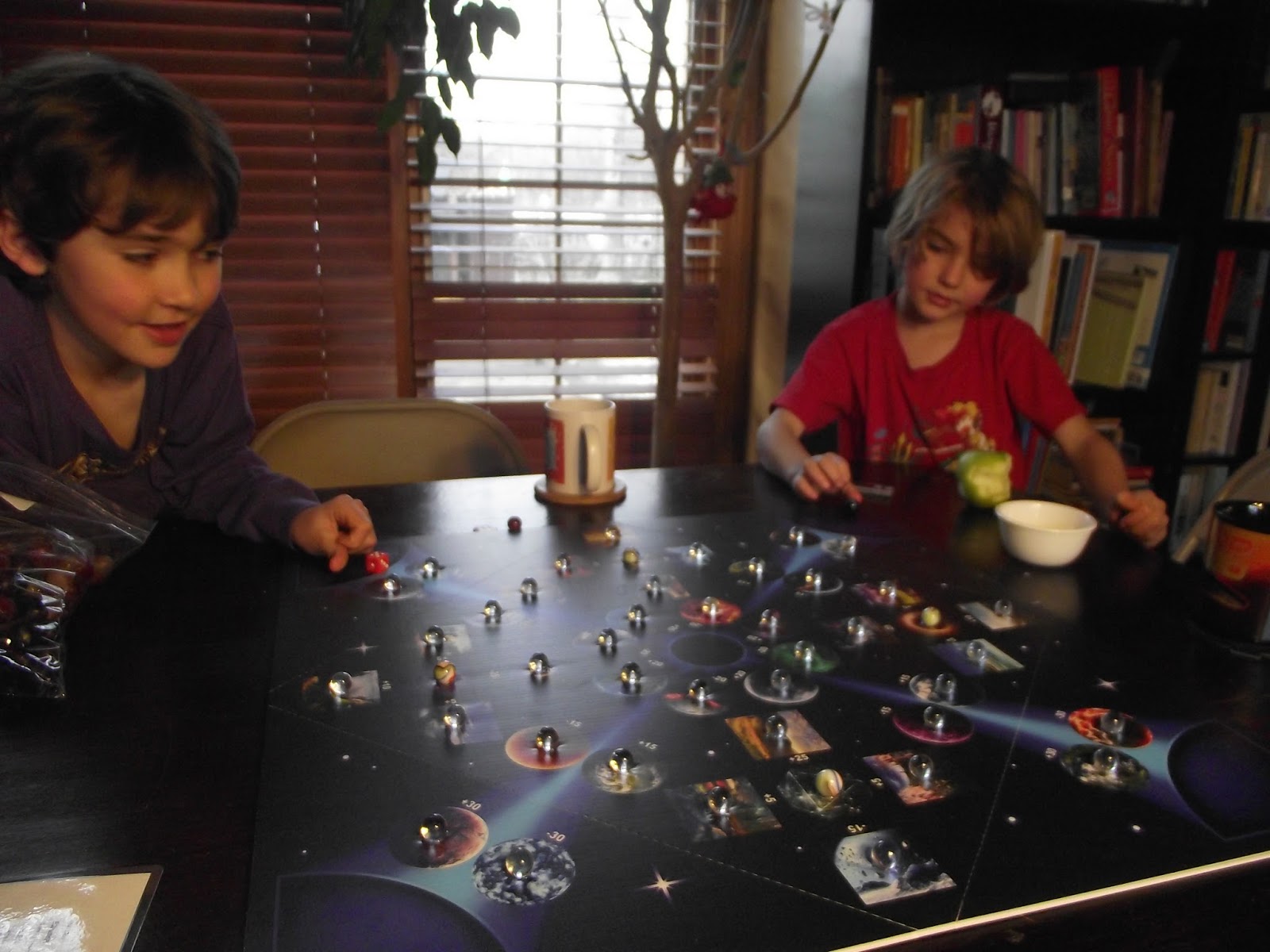
The Universe is a dexterity game where players have three ships (a D6 die, a marble, and a disc) that they flick or roll around a game board populated with 44 planets and a black hole.  Each planet has a marble bumper glued to its center and is worth positive or negative points (ranging from -30 to +30) if your ship lands on it, except for four planets that award a bonus round (more on that later).  The game is for 2-6 players (according to the Board Game Geek listing, although it only came with pieces for four players) and plays in a varying amount of time depending on how many rounds you play (recommended is 10) and how many bonus rounds are earned (theoretically a skilled player could get into an endless loop of bonus rounds for a game that doesn't end until everyone gives up).

Setup and gameplay is pretty easy.  Simply unfold the game board and choose a set of pieces in one color and a corner to shoot from.  After randomly deciding who should start, players take turns choosing one of their three ships to flick (or roll, or propel in pretty much any other manner) from a corner base into the center of the board.  There are two planets right in front of each base that must be cleared (although a ricochet back onto those planets is legal).  Ships are left where they land until after everyone has launched all three of their ships, after which scores for the round are calculated.  Planets are worth their face value, either negative or positive, however the D6 die is a multiplier so whatever face is up multiplies the score for the die's planet by that amount.  Clear off all the ships and repeat.

If a player's ship ends up on the central Black Hole space, that ship is lost for the following round.  If a player's ship ends up on one of the four octagonal shaped planets the player gets a bonus round.  In a bonus round a player gets the entire board to himself and gets to shoot his three ships again.  But this time all the planets are worth positive points and instead of using a D6 the player gets to use a D20.  Also, the Black Hole awards an additional bonus round instead of causing the player to lose a ship.  So, theoretically a player could play endless bonus rounds, earning up to 635 points per bonus round.  Finally, after earning a bonus round a player gets a small ring to 'own' a planet.  The ring is worth 5 points and is placed on the marble bumper for any planet.  In future rounds, if someone lands on a planet owned by a player the owner also gets the points for that planet (always positive for the planet owner).

There were a few scenarios that weren't exactly discussed in the rules, but the game is so simple that they weren't really issues.  The game doesn't specify that players have to launch their ships from the same corner every time, but we each chose a corner as our own base.  Also, we decided that if a ship landed on an octagonal planet during a bonus round they don't get an additional bonus round.  Another slight change we made was to pass a Starting Player token clockwise each round so that everyone had an equal chance at playing first.

There are also a couple of simple variants to the game included in the instructions that focus a little more on skill and not on points.  One is to place rings on each planet and players take turns trying to collect rings by hitting planets and collecting the rings of hit planets.  The other is a variant of the classic HORSE where players try to replicate each others' shots, earning a letter if they fail.  Neither of these variants have detailed rules, however they're simple enough to play.

Final Thoughts

I have to be honest, when Diletostra first contacted me about reviewing The Universe I wasn't thrilled with the game.  I looked at the pictures and videos on his website and replied that I didn't think the game would be a fit for my game group.  It looked too random and too reliant on chance as opposed to skill or strategy.  Despite my reservations though, Diletostra was persistent an insisted on sending me a copy of the game, claiming there was no way I could make an assessment of the game without playing it.  So I agreed to review the game since he really seemed to want to send me the game.  "You seem to really know your games and what works for you. Offering you a free game that you could really do whatever with."  A few days later I received a large box wrapped in brown paper.

That's one big package!
The first thing that struck me about The Universe when it arrived was the size.  The box is HUGE!  The Universe arrived in a pizza box for a 20" pizza (thankfully unused), so the box is almost 21"x21"x2". The inside of the box has a thin plasticy material glued as a liner and black craft ribbon with velcro as straps to hold everything in place (sort of).
It didn't arrive in 30 minutes or less, or piping hot, but it was free...
Inside the box is a folded game board.  It's actually a pretty spiffy design that works well to have a board without any folds or cuts in the middle that might impede the flow of pieces. It's a square board with a 45 degree rotated square in the center. The corner triangles fold under to make the board smaller. Unfortunately it doesn't seem to be quite small enough though.  The resulting game is still about 18" square and as I mentioned, the box is huge.  Unfolded the game board is 25" square. The board is printed on corrugated plastic (like what a political yard sign might be made of) with marbles glued on to the planets (two of which fell off in transit, a third fell off during gameplay - they were easily hot glued back on though). The components are marbles, dice, and discs in four colors (blue, red, green, and yellow). Plus about 50 tiny black rubber o-rings. Rules are a single side of a letter sheet, laminated. Plus, I received a business card with a tiny, unique painting on it and the designer's website handwritten on the back (however it was stuck to the inside of the box with a loop of packing tape so I couldn't see the website until I peeled off the card).
Rules, a bag of components, and two
rogue planets (broken marble bumpers).

Strapped in for safety.
Yes, that is a business card...

Overall the components are a mix of a cheap board, cheaply affixed marble bumpers, average quality dice, typical wooden disks, and nice colored marbles.  The biggest problem with the components, however, are the black rubber o-rings used to mark planets as owned.  The problem isn't the o-rings themselves, but the fact that they are all black.  So after a couple of bonus rounds there's no good way to tell who owns what planets.  Fortunately we had a kids educational game that had colored rings we used instead.

Four dice, four marbles, four tokens, a D20, the game board, and a
bunch of o-rings make up the components.

The game is obviously hand made and a project of love by the designer, however you know what they say about the eye of the beholder and love's eyesight...  Looking past the nice, but not particularly great artwork and poor graphic design, ignoring the quality of the corrugated plastic board, pretending the glued on marble bumpers don't have to be reglued back on occasionally, and forgetting that I really didn't think there was much game here to begin with, I played this with my family this past weekend and gave it a fair shot.

We played a full ten rounds, as recommended, and had three bonus rounds added in.  The game lasted just a bit less than an hour for four of us.  By the time the hour was up we were ready for the game to be over.  Final scores were 235, 285, 350, and -25.  As I suspected, the game was about 93% luck, 5% skill, and 2% strategy.  The only strategy in the game is to aim for higher point planets (everyone has a 25 point planet that is a fairly straight shot and can net 150 points if you land you D6 there with the six side up) and bonus planets (again, a fairly straight shot and not too difficult to hit with your disk).  Defensively you can try to knock opponents off of the bonus spaces, but generally you're better off to just try to get on a bonus yourself.  There is a bit of skill required to get your die or disk onto a high scoring space or bonus space, but it's not much.  And the marble is pretty much just a random shot in the dark.  Unless the board is perfectly level, doesn't have any warps or divots, and isn't jostled at all during gameplay, the marbles just go pretty much anywhere.  The marbles are best used to try to knock someone else's disk or die off of a good planet, or to just shoot and hope for the best.
Scores were all over the place...
There are a few things that could improve the game drastically.  First we have the components.  The o-rings for owning planets need to be colored.  There is no way to tell who owns what otherwise.  The game also needs to be on a solid board, not a cheap plastic board that will easily warp and dent, particularly if the marbles are to remain.  And around the border of the board should be either a slightly raised frame or indented gutter to keep the marbles from rolling off so easily.  And ideally, each planet would have a very slight recession around the bumpers so that the marbles would 'gravitate' toward a planet slightly.  The recessions don't have to be big (so there's still a chance of marbles stopping in open space) or deep (so that marbles can be knocked away from planets still), but a little something would help add some skill to the paths of the marbles.  The problem though, is that the game board is already huge as it is.  Making it solid wood would just make it that much more difficult to package and store.  And you need a solution that doesn't have obstructive seams in the middle of the board.  So I'm not sure what the right solution to this would be.
Marbles were just as likely to end up on a planet as they
were to just roll randomly around the board.
Another improvement would be to organize the points on the board better.  Right now there's an even distribution of positive and negative point spaces on the board (a few more positive spaces than negative, but everyone is equidistant from every type of space).  Right now there are negative spaces right next to positive spaces.  Most other dexterity games reward accuracy, combined with distance.  Higher point spaces are closer to a central target (e.g. darts or horseshoes, or crokinole), or further away from the starting area, but without going too far (e.g. shuffleboard), or being able to accurately hit a specific space (bags, skee ball, snapshot).  The Universe tries to combine many different methods and it results in a board that relies more on luck than skill.  A better organization of targets so that negative point spaces had to be maneuvered around in order to hit positive point spaces would encourage aiming and skill.  Better yet, eliminate the negative point spaces and make them all positive, but make more challenging spaces to reach worth more points.  Maybe have planets that are owned be negative to other players and positive to owners even if someone else lands on them (e.g. paying rent).  I also don't like the idea that bonus rounds can continue indefinitely, so some other benefit to landing on the black hole would eliminate that (maybe the black hole is 50 points, or just keep the black hole with its original penalty of losing that ship for the next round so there's still a bit of risk in a bonus round).

I do have to say that my family had fun playing The Universe.  We laughed a lot during the game.  However most of that was not because of the game itself, it was because we were doing an activity together.  My sons loved the game, but that was mostly the novelty of flicking pieces around the board.  They would have had just as much fun rolling marbles around the table trying to knock over dominoes.  The points were, pardon the pun, pointless in the overall entertainment value of the game.  It was just fun to roll the marbles and watch them trace wiggly, unpredictable lines around the board, or to flick disks at other players' dice and marbles.  The Universe reminded me of games I used to make up and play at fast food restaurants, like taking turns sliding a salt shaker across a table trying to see if you could get it to hang off the edge without falling, or flinging pennies to see who could get closer to a quarter.  The Universe has all the mindless fun of that, but on a huge, colorful board.  If this is something you think is worth $35 you can check out the Kickstarter campaign here: http://kck.st/1k2u6Bs

Preliminary Rating: 3/10
This review is of a prototype game.  Components and rules are not final and are subject to change.

Did you like this review?  Show your support by clicking the heart at Board Game Links , liking GJJ Games on Facebook , or following on Twitter .  And be sure to check out my games on  Tabletop Generation.


GJJG Game Reviews are independent, unpaid reviews of games I, George Jaros, have played with my family and friends.  Some of these games I own, some are owned by friends, some are borrowed, and some are print and play versions of games.  Where applicable I will indicate if games have been played with kids or adults or a mix (Family Play).  I won't go into extensive detail about how to play the game (there are plenty of other sources for that information and I'll occasionally link to those other sources), but I will give my impressions of the game and how my friends and family reacted to the game.  Quick Reviews will only get a single rating of 1-10 (low-high) based on my first impressions of the game during my first few times playing.  Hopefully I'll get more chances to play the game and will be able to give it a full review soon.