Monday, April 11, 2016

Quick Review - Starving Artists - Kickstarter Preview

Starving Artists
Designer: Mike Wokasch
Publisher: Fairway 3 Games, LLC
Quick Review - Starving Artists - Kickstarter Preview
Disclaimer
Back in October I went to the Madison Protospiel event and got to play a number of great games.  One just recently funded on Kickstarter (see my review of Flag Dash), and now a second is launching as well.  Starving Artists was originally created to compete in The Game Crafter's survival game design contest.  And guess what, it won!  I played a 4 player game of the contest version in Madison with the designer, Mike Wokasch, and his son and when I heard it was coming to Kickstarter with a few updates, I was super excited.  I have a degree in fine art (sculpture to be exact, despite a career in web development), so the theme and art in the game really grabbed my attention.  What's more, my wife loves the theme and artwork also, so this is a perfect game for my family, thematically anyway.  Read on to see if the gameplay matched my expectations.

Overview:
Starving Artists is a 2-4 player game for ages 10+ (although my 6 and 9 year old gamer sons played it just fine).  It takes about 45 minutes and comes packed with gorgeous, classic masterpiece paintings from many great artists.  The Kickstarter launches on April 19 and the game will be available for $29.

In Starving Artists, each player is an artist trying to survive by completing paintings.  There is one resource in the game, paint, and it is used to both paint your paintings and as a currency used both to purchase canvases and as earnings when selling completed paintings.  Players must also manage their meals, which is the equivalent of health or strength - if you hit zero meals left you are out of the game and the end game is triggered.  The paint is represented by cubes in seven different colors: Red, Blue, Yellow, Green, Purple, Orange, and Black.  Each canvas in the game requires a different combination and number of paints in order to complete the painting.  Once a painting is completed it can be sold to both earn new paints and to gain a few meals.
You'll need to paint some masterpieces in order to survive!

Gameplay:
The game is played in a series of rounds.  At the start of each round players have to feed themselves, pass the first player token, and then add some paints from the main stock into a common payday pile.  Then players will get to take one action at a time until each player has taken two actions.  Between rounds there is a selling phase where players can sell any completed paintings before the next round begins.
The choices are simple, but the decisions are difficult.  There's a lot of depth here!

Actions available each turn include Work, Paint, and Buy.  With Work you get to draw three paint cubes from the bag.  To Paint you can apply up to four paint cubes to their corresponding spaces on a canvas you own.  And when you Buy you purchase a canvas from the market (for 1, 2, or 3 paints depending on how long the canvas has been available) so you have something to paint on.  Paints used to purchase the canvases go into a central payday pile.  You are also allowed to trade paints from either the payday pile (at a rate of 2 to 1) or the main paint bag (at a rate of 4 to 1, or possibly 3 to 1 depending on the final rules).
As you paint more you'll be able to add paints to the canvases you are working on completing.
After each player has taken two actions the selling phase starts.  Any players that have completed painting canvases can then sell the canvas.  Each canvas has a value that it is worth and a number of meals that it provides.  When a completed canvas is sold the player can increase his meals by the amount of the canvas and then take the number of paints indicated from the payday pile (paints used on the canvas go back into the bag).  Then that canvas is worth a certain amount of points at the end of the game.  The catch is, if more than one player sells a completed painting, paints are collected from the payday pile in a round robin fashion.  The player with the most valuable painting gets to choose four paints first, then the next most valuable painting nets that player two paints, and each other player then gets one paint each.  This repeats until each player has collected all the paint they are allocated or until the payday pile is exhausted.  So if you sell at a time when other players are selling and the payday pile is fairly empty there's a chance you won't get as much paint as you expected.  But waiting to sell a painting means you'll get closer to starving as you run out of meals.
The Scream, worth 1 meal, 8 paints, and 2 points, is one of the many famous paintings included in the game.

The game goes until either one player paints a certain number of paintings (depending on the number of players) or until one player runs out of meals (and either starves or gets a real job, depending on how hard core you want the theme to be).  If one player runs out of meals then the other players finish that round and the game ends.  The player with the most points worth of sold canvases at the end of the game is the winner.
Fun for the whole family!  And learn a bit about famous paintings, too!
Final Thoughts:
The use of paints as both a resource and currency, and the way selling canvases results in a bit of marketplace competition creates a great economic engine that adds a bit of player interaction to a game that is otherwise a pretty solo experience.  Each player is working to manage their own paints and canvases, but it's important to pay attention to what your opponents are working on, too so that you can try to sell your canvases at an optimal time, decide if you should buy a new blank canvas now or wait until another player buys a canvas to make the one you want cheaper, and pay attention to what paints other players are collecting.  Coupled with the great theme and artwork, this makes Starving Artists a great game for both casual and serious gamers.  A game lasts about 45 minutes, which is a perfect length (the first prototype I played went on a little too long, so the revised rules really improve that).  The mechanics were simple enough that my six year old son played fine (he's used to much more complex games though) and the strategy was deep enough that my gamer friends really enjoyed the game, too.
The game was great for both my family and my gamer friends!

I did have a few concerns with some of the randomization that happens with the paint cubes that come out in the game though.  There is a lot you can do to control your own fate, but sometimes the colors you need just don't come up when you work and aren't available in the payday pile for trade.  In those cases there's just nothing you can do to prevent yourself from starving.  That's one aspect of the game that is still being playtested and balanced.  A few solutions that I suggested include being able to paint a portrait by trading in four paints for one meal.  Or being able to sell a completed canvas a second time to get those meals, but lose the points the canvas is worth.  Mike Wokasch had a few other things he was working on, too, and I'm confident this little hiccup will be resolved by the time the campaign is completed.  It's a minor issue and the game was still a ton of fun.  And at the very least, it's an easy house rule to add if you need to.
Sometimes the colors you need just aren't available.  I expect that to be fixed in the final game though since it's an easy fix, mainly just a decision on which method works best for the game.

The only other concern with the game is the reliance on accurately identifying the colors.  This will definitely be a challenge for colorblind players and can be difficult in lower light situations even for those without color sensitivities.  There are a few tips in the rules for helping out color blind players and each canvas has a list of the quantities of each color paint required, but that doesn't help with identifying the cubes as they come out of the bag.  Yellow and Orange are particularly difficult to tell apart at times.  I'm not sure if there's a good, cost effective solution (different shapes for each color might work, but then pulling them out of the bag becomes less random).  Still, this is a minor issue in a game that looks fantastic in part because of the great colors.
The colors of the cubes are bright and vibrant, but sometimes difficult to tell apart.

So, overall I really, really like Starving Artists.  The theme is wonderful, the artwork is gorgeous (it has to be since it's composed of some of the greatest paintings of all time), and the gameplay is simple yet strategic.  Starving Artists would be an attractive addition to any game collection and is sure to capture the attention of gamers, families, and art lovers alike!  Plus, the whole thing is packed into a nice, portable sized box.  If you follow my blog you probably know that I really like big games in small boxes.  The Tiny Epic games are some of my favorites, and Starving Artists is a great addition to my collection of small, portable games with big gameplay.  Now, let's see if Mike can come up with an expansion for classic sculptures!

So check out Starving Artists on Kickstarter starting April 19.  Visit http://www.starvingartistsgame.com/ where $29 will get you one copy of the game shipped in the US ($10 worldwide shipping).

Preliminary Rating: 8/10
This review is of a prototype game.  Components and rules are not final and are subject to change.

Did you like this review?  Show your support by clicking the heart at Board Game Links , liking GJJ Games on Facebook , or following on Twitter .  And be sure to check out my games on  Tabletop Generation.


GJJ Games is proud to be a part
of the Everything Board Games Network.


GJJG Game Reviews are independent, unpaid reviews of games I, George Jaros, have played with my family and friends.  Some of these games I own, some are owned by friends, some are borrowed, and some are print and play versions of games.  Where applicable I will indicate if games have been played with kids or adults or a mix (Family Play).  I won't go into extensive detail about how to play the game (there are plenty of other sources for that information and I'll occasionally link to those other sources), but I will give my impressions of the game and how my friends and family reacted to the game.  Quick Reviews will only get a single rating of 1-10 (low-high) based on my first impressions of the game during my first few times playing.  Hopefully I'll get more chances to play the game and will be able to give it a full review soon.

Wednesday, April 6, 2016

Quick Review - PWNs - Kickstarter Preview

PWNs: A Game of Strategic Mayhem
Designer: Ryan Boyle
Publisher: AWRY Corp, LLC
2-4p | 20-45m | 10+
Quick Review - PWNs - Kickstarter Preview
Disclaimer Support me on Patron!
Back in September I was contacted by Ryan Boyle about reviewing a whimsical combat game he was working on called PWNs (pronounced 'pones').  It was still in development at that time, but it looked interesting and I said I'd be happy to play it when it was ready.  It took about six months, but when it was ready to play Ryan sent me a prototype copy.  I've played a few times now, but was it worth the wait?

Overview:
PWNs is a light strategic combat game with a lot of chaos and mayhem.  The game is for 2-4 players ages 10+ (although my 6 year old played without any problems at all) and takes about 30-45 minutes.  PWNs will be on Kickstarter in mid to late May.  I'll update this review when the Kickstarter details, like price and launch date are available.  PWNs is now on Kickstarter, through June 22, 2016!  Be sure to check out the PWNs Kickstarter Campaign where you can grab a copy of the game for $34 ($39 for a deluxe version with exclusive cards and abilities) plus shipping.
PWNs are on the march!
In PWNs each player controls a set of pawns (called PWNs) and the goal is to eliminate all opponent PWNs on the board.  Each PWN starts out with 5 HP (Health Points) and will be able to move, attack, and heal throughout the course of the game.  If a PWN's HP is ever reduced to 0 that PWN is KO'd (Knocked Out) and is out of the game.  The last player with surviving PWNs is the winner.  The battle is conducted on a grid of 64 squares, much like a chess board, but instead of black and white squares each square is a different terrain: mud, grass, dry grass, and water.  Throughout the course of the game different effects will change the terrain, converting grass to mud, mud to holes, setting dry grass on fire, freezing lakes to ice, and more.  Some of the terrain is hazardous to the PWNs, some is just more likely to become a hazard.
Holes and lakes are two of the types of hazards that the battlefield will have.
Gameplay:
Playing PWNs is very simple.  Setup consists of each player selecting their team (there are no asymmetrical powers, so even though each character has flavor text the only real difference is the colors) of PWNs and their corresponding mats, setting the starting HP to 5 for each PWN, and drawing a number of cards that varies depending on the number of players.  Then you choose 4 random starting tiles (square tiles composed of a 4x4 grid of 16 different terrain spaces).  These are randomly assembled to create an 8x8 grid.  Finally each player places his four PWNs in the first two rows on a side of the playing area.  Currently these starting tiles are just cardstock weight squares, but in the final version I'm told they'll be thicker chipboard mats, held together with a frame, kind of like how the Catan hexes are held together with a frame.  This should make for a nice, solid playing surface as opposed to the somewhat floppy prototype playing area.
The cardstock starting tiles were annoying in the prototype, but fortunately they'll be nicer chipboard mats in the final game.
Once all the PWNs are placed the first player begins.  Each player's turn consists of three phases: Move, Action, and Health.  During the Move phase a player may move the PWNs up to three spaces total.  They can move one PWN three spaces, three PWNs one space, or any combination that totals 0-3 spaces.  Next comes the Action phase.  This is where the meat of the game comes into play.  During the Action phase players get to choose one PWN to attack opponent PWNs.  Once the Action phase is resolved players can play any Health cards during the Health phase.
Managing HP is important, otherwise your PWNs wind up KO'd.
There are two types of cards that can be played during the Action phase: Elementals and Attacks.  Elemental cards generally affect the terrain of the board.  If a PWN happens to be unlucky enough to be standing on an affected space on the board the may get some damage done.  Sometimes there may be a satellite that crashes into the earth, setting spaces on fire.  Or maybe a hurricane blows forth, blowing all PWNs in a certain direction, possibly into a hazard.  Elemental cards are great for adding a general sense of chaos to the board, ensuring that nothing stays the same for long.
Elemental cards can not only set the grass aflame, but also turn water to ice, cause lakes to expand, and more.
But Attack cards are the really fun part of the Action phase.  PWNs comes with a wide variety of Attacks.  Everything from Molotov Cocktails to a Bag of Stinky Leftovers to Halitosis is fair game.  Some Attacks directly damage PWNs.  Some send a PWN running into hazards.  Each one is great, but some are more useful in certain situations.  You don't want to don the Scary Mask and just make a PWN run across the board, you want to scare that PWN into a hole, fire, or crash him into another PWN (which does damage to both PWNs).
Oh, the choices...  I think I'll use a Poison Dart and keep my Block in case I'm attacked...
But not every Attack card is guaranteed to be successful.  A few require rolling a die to determine just how destructive they are (like, does a vulture swoop down for the attack or a dragon).  And most Attacks can be avoided if the victim plays an appropriate Reaction card.  Some Reaction cards simply protect a PWN from being attacked, or let them dodge out of the way, but some Reaction cards turn the tables on the attacker and make him the attackee!  Using the Sniper Rifle on a PWN that has a Reflector could be the end of the attacking PWN!
Oh yeah, that's a good card to play on your brother!
During any phase of a player's turn they can trade in a card from their hand to gain a new card from the deck, so sometimes it's worth it to just lay low and shuffle cards around until you have what you need to move in on a big strike.  But you need to be careful, because sitting in one place for too long makes you a prime target!
Beethoven and Happy are trapped between the giant lake and the wall of flames.
Final Thoughts:
The concept behind PWNs is simple, but it is hugely fun.  Sending these PWNs around the board, attacking your opponents, changing the terrain, is all hugely satisfying.  This isn't going to be your 3 hour, highly strategic Euro game.  It's not even an Amerithrashy strategic war game.  It's simply a chaotic battle that gives the feel of a bunch of unorganized kids having an epic paintball battle, but with slightly odder weapons.  I'm not sure I'd recommend the game for a group of serious gamers (although it could be a good starter or end of the night game just for a few laughs), but this is an excellent game for families.  My sons (6 and 9) and their friends absolutely love PWNs.  I think it's the only Kickstarter preview I've had where they've pulled it out to play on their own.  I've played with adults, too (although never a game with only adults) and everyone has always had a great time.
There are always hilariously fun choices to make.
There are only a few minor issues with the game as it is now, and some of these issues are simply because it is a prototype.  I mentioned that the game will be coming with thicker starting tiles instead of the thin cardstock tiles.  This is almost a necessity.  The game is fun, regardless, but the thin tiles are just a pain to play on.  But when I mentioned it to the designer, Ryan said it's already planned to be fixed in the final game.  Also, a minor concern is that some effects that apply to PWNs (like being frozen, poisoned, trapped in ivy, etc.) are difficult to indicate.  We've been playing by using the card that caused the effect to indicate which PWN has been effected, but Ryan has indicated that they'll be adding better markers to indicate various statuses.  A few of the interactions between attacks and reactions were a bit confusing, too, but that should all be clarified with some adjusted text and FAQs in the rules.
Mr. Decaf is trapped in ivy and Houdini is on the run.
I think my only big complaint about the game is the player elimination aspect.  The current rules say that you play until there is only one team of PWNs left.  In a 2-player game this is fine, but in a three or four player game there can be a significant amount of time between when the first player is eliminated and when the game finally ends.  PWNs is generally a pretty quick game, but being eliminated 15-20 minutes before the game is over is never any fun, especially when some of the players are kids.  The good thing is that I made a suggestion to Ryan and he really liked it.  Instead of playing until one team is left, play until one team is completely eliminated and end the game right there.  The winner is the player with the most PWNs remaining, or with the most HP if there's a tie.  This make sure no one is left out at all and also makes sure that no one is ganging up on any other player.  It also speeds up the game a little bit, too.  The games I played with this variation were a lot more fun for everyone and added an extra level of strategy, too, since you have to decide who to attack because you don't want to end the game when someone else has too many PWNs left.  So it's very possible that this will make it into the final rules, either as the primary rule set or as a variant to the last-PWN-standing rules.
Play until one player's team is eliminated and then determine the winner, that way no one has to feel left out.
So overall I really liked PWNs for a fun, crazy family game.  It offers a bit of light strategy with a lot of funny action.  I never felt like I was a slave to the game, but also never felt like any player had a huge advantage over any other player.  Every game I played ended up being a close game and every game was a ton of fun.  PWNs is a roller coaster ride of mayhem and strategic chaos!  My sons, their friends, my friends, and I all had a great time playing PWNs!  
I think this is the only Kickstarter preview I've done where the kids insisted on playing without me.
If you want something that is light, plays quickly, and is full of crazy family fun, check out PWNs on Kickstarter through June 22, 2016!

Preliminary Rating: 7.5/10
This review is of a prototype game.  Components and rules are not final and are subject to change.


Did you like this review?  Show your support: Support me on Patron! Also, click the heart at Board Game Links , like GJJ Games on Facebook , or follow on Twitter .  And be sure to check out my games on  Tabletop Generation.


GJJG Game Reviews are independent, unpaid reviews of games I, George Jaros, have played with my family and friends.  Some of these games I own, some are owned by friends, some are borrowed, and some are print and play versions of games.  Where applicable I will indicate if games have been played with kids or adults or a mix (Family Play).  I won't go into extensive detail about how to play the game (there are plenty of other sources for that information and I'll occasionally link to those other sources), but I will give my impressions of the game and how my friends and family reacted to the game.  Quick Reviews will only get a single rating of 1-10 (low-high) based on my first impressions of the game during my first few times playing.  Hopefully I'll get more chances to play the game and will be able to give it a full review soon.

Wednesday, March 16, 2016

Tiny Epic Kingdoms: Heroes' Call - Unboxing

I have been a huge fan of the Tiny Epic series by designer Scott Almes and publisher Gamelyn Games ever since I saw Tiny Epic Defenders shortly after I discovered Kickstarter.  I was disappointed that I hadn't found out about Tiny Epic Kingdoms when its campaign was running, but was excited that I could buy a copy in my pledge for Tiny Epic Defenders.  Fast forward two years and the Tiny Epic games are still some of my favorite games and I've been backing each one in the series on day one.

Last summer was the campaign for the first full expansion for any of the Tiny Epic games; Tiny Epic Kingdoms: Heroes' Call.  I have eagerly been awaiting the game since last July and today it finally arrived.  It was only about 2 weeks later than projected, so that's pretty good.  And the quality is pretty much everything you would expect out of a Gamelyn Games production!  The box, card, print, and component quality is outstanding.  I only have two super minor issues, but they're super tiny.  First is the gold crown tokens.  They're made from plywood instead of solid wood like the other components appear to be.  This is probably due to the manufacturing process used to make them, but it does stand out a bit.  Second is the colors of the components.  They're ever so slightly different from my 1st Edition Tiny Epic Kingdoms.  It's most noticeable in the orange, purple, and white pieces, but even there it's only if you look closely, and it's probably not a problem if you bought the 2nd edition of Tiny Epic Kingdoms.  And it definitely won't affect my enjoyment of the game.

Anyway, without further ado, here are a bunch of pictures of the game and the components, including a few of TEK:HC bundled with TEK.  Most won't have captions, but a few (particularly showing the color comparisons toward the end) will.  Enjoy!  And as always, if you like this review please show your support by clicking the heart at Board Game Links , liking GJJ Games on Facebook , or following on Twitter .  And be sure to check out my games on  Tabletop Generation.


Here you can see the difference in the plywood crowns. 
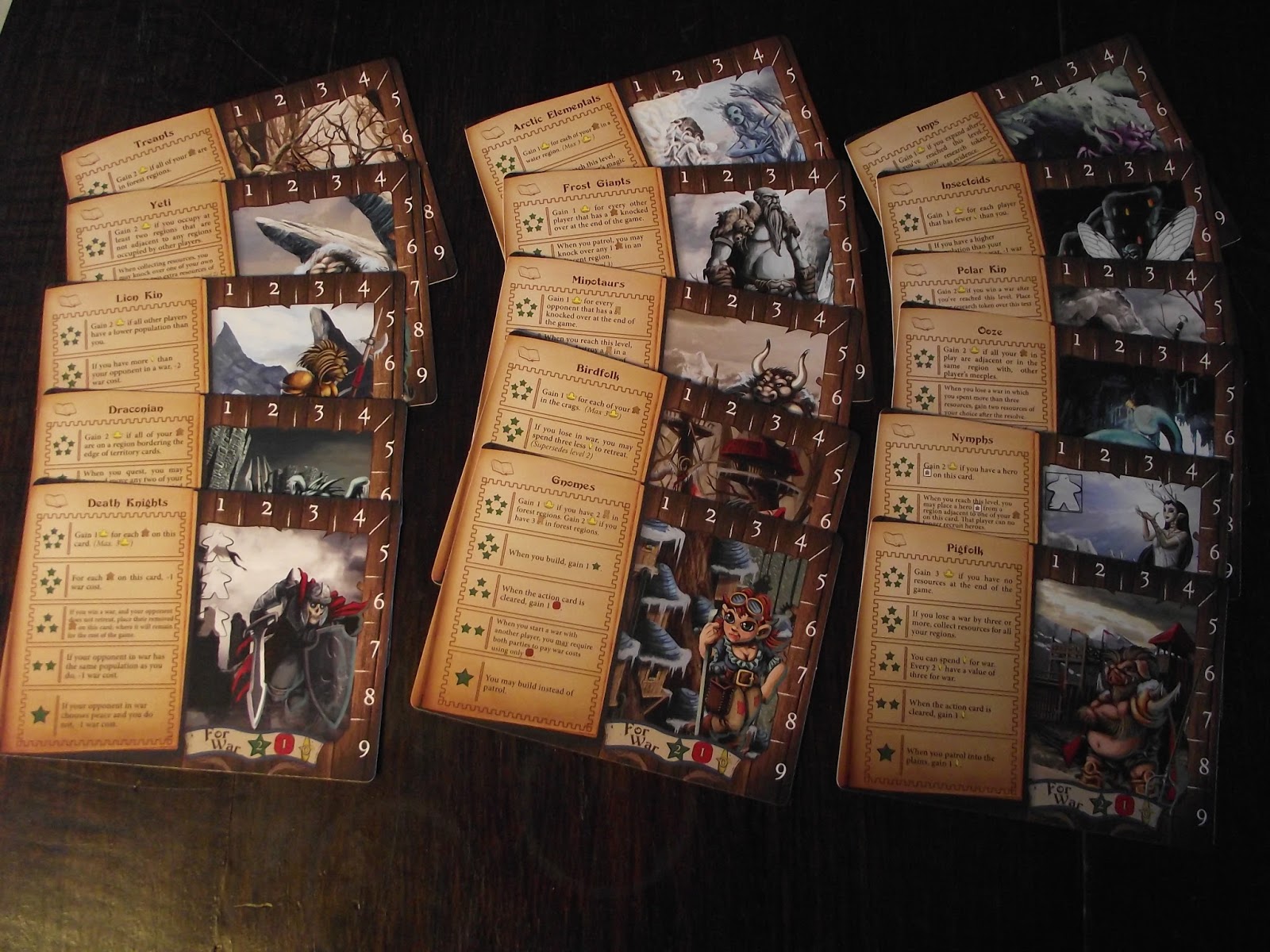
Faction Card Fronts 
Faction Card Backs 
The Territory Cards are double sided. 
Solo play day side. 
Sol play night side. 
Hero cards. 
Here you can see the slight difference in the colors.  The towers to
the left and the small meeples are from the 1st Edition.
The new orange is more vibrant and like a day-glow orange.
The white is just a little more off-white or gray.
The purple is also more vibrant.
The blues are very close, but the new blue might be a tad duller.
The black is still black.


GJJG Game Reviews are independent, unpaid reviews of games I, George Jaros, have played with my family and friends.  Some of these games I own, some are owned by friends, some are borrowed, and some are print and play versions of games.  Where applicable I will indicate if games have been played with kids or adults or a mix (Family Play).  I won't go into extensive detail about how to play the game (there are plenty of other sources for that information and I'll occasionally link to those other sources), but I will give my impressions of the game and how my friends and family reacted to the game.  Quick Reviews will only get a single rating of 1-10 (low-high) based on my first impressions of the game during my first few times playing.  Hopefully I'll get more chances to play the game and will be able to give it a full review soon.